by indigiseo | Mar 8, 2026 | Blog, Health
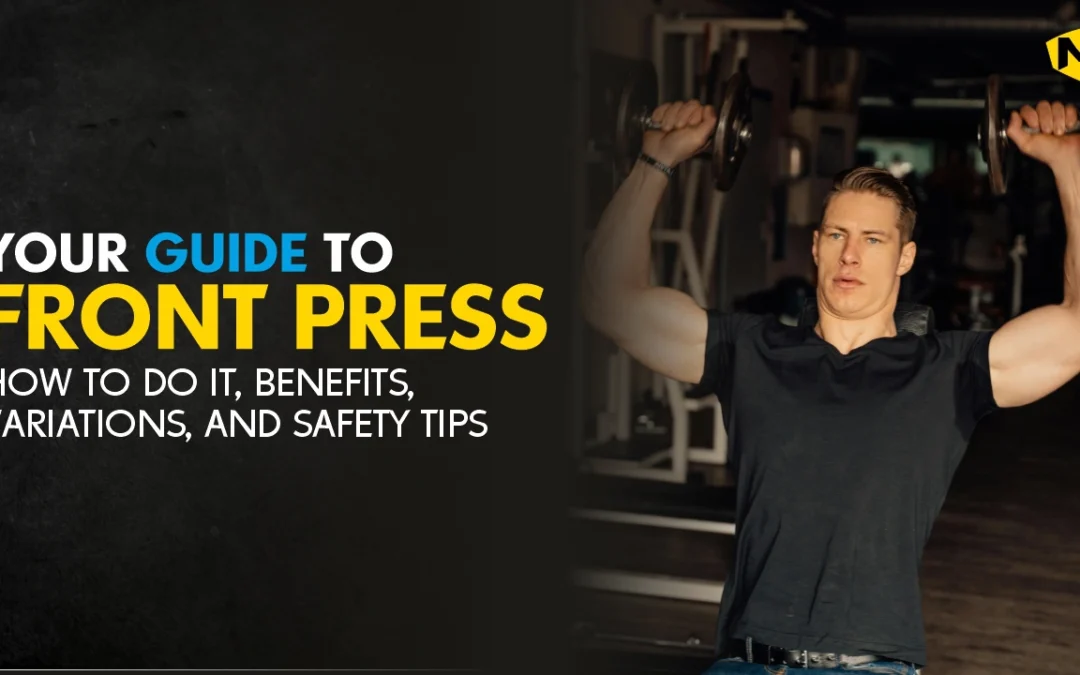
Your Guide to Front Press: How to Do It, Benefits, Variations, and Safety Tips
Ever heard of the Front Press?
It is also known as the Front Military Press. It is a compound exercise where you target your shoulder muscles, i.e. your deltoids. It’s also a variation of the overhead press, so you push weights from the front of your body instead from the sides.
In this blog, let’s understand what Front Press is all about, its benefits and variations, safety guidelines, and learn a step-by-step guide on how to perform it.
What is the Front Press?
The front press is a strength training exercise. You lift a weight of your comfort, be it a dumbbell or barbell, and push it from the front of your body to overhead. This exercise makes sure that the joints and several muscle groups work at once.
The main muscles focused here are the deltoids, trapezius, and triceps.
How to Do the Front Press?
Here’s how to perform the front press safely and effectively:
- Stand with your feet shoulder-width apart. Your toes should be facing forward or slightly outward.
- Hold the weight at shoulder height. Your hands should be on your shoulder level, width apart, and your palms facing forward.
- Push the weight straight up over your head, fully extending your arms.
- And then, lower the weight back down to the starting position steadily in motion.
- Repeat this exercise (3 sets of 10-15 reps is a good start).
[Disclaimer: Do consult and take guidance from a certified trainer before beginning any exercise program.]
Benefits of the Front Press
Why should you include the front press in your workout routine?
Here are a few reasons:
Improved shoulder front press strength and development: Your deltoids, trapezius, and triceps are being targeted. This helps to build strong and broad shoulders.
Overall Strength: You are engaging multiple muscle groups. This leads to overall strength gains.
Improved Athletic Performance: You can boost your performance in sports. Especially sports with overhead movements, like basketball, volleyball, and tennis.
Better Posture: Here, when you build a broader shoulder, you improve your posture as your shoulders are pulled back, which opens up your chest.
Variations of the Front Press
There are other variations to target these muscles so you can keep your workouts interesting:
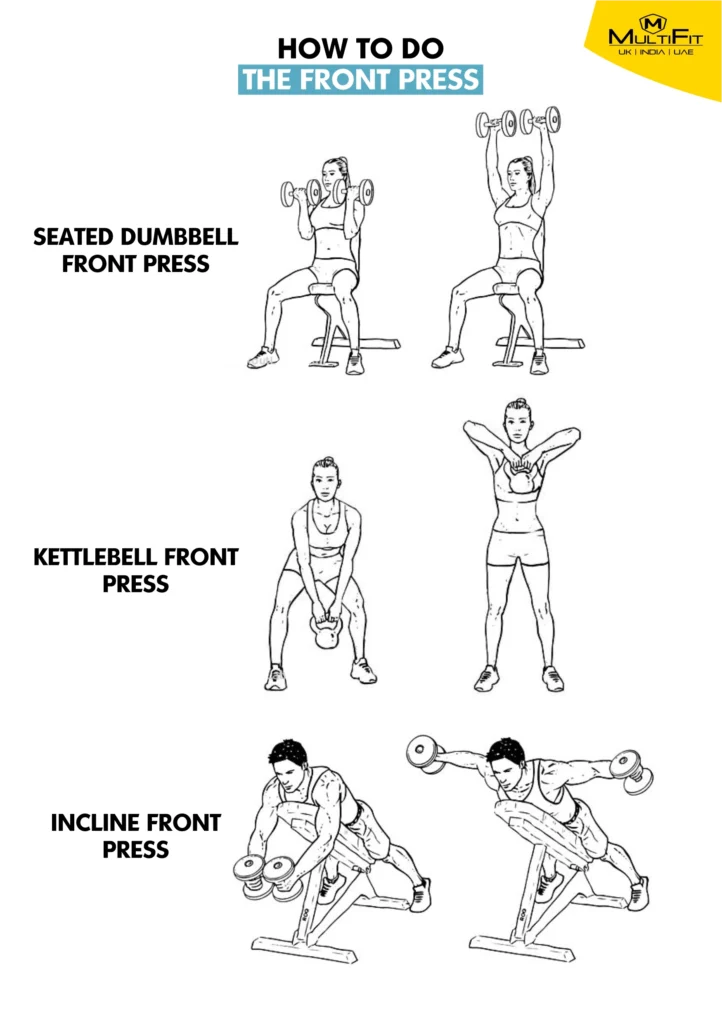
- Seated Dumbbell Front Press: While seated, use dumbbells so you can target your shoulders from a different angle.
- Kettlebell Front Press: With kettlebells, your core muscles play an important role. Here, your core muscles help in creating stability while doing the exercise.
- Incline Front Press: Perform the front press on an incline bench; your muscles targeted will be the upper chest, shoulders, and triceps.
Safety Tips
To make sure your workout is done in a proper manner, keep these in mind:
- Warm Up: Always do a proper warm-up for your shoulders and upper body with light cardio and stretching.
- Maintain Proper Form: With good form, you can avoid future injuries. I would definitely recommend having a trainer or head coach while performing the exercise.
- Start Light: Begin with a weight you can handle while maintaining good form. Slowly increase the weight as you get stronger.
- Avoid Arching Your Back: Keep your back straight, and you can prevent injury.
Conclusion
The front press is an exercise that can help you build stronger, broader shoulders.
You also boost your athletic performance and improve your overall health. By following this guide and working with different variations while prioritizing your safety, you can make the most of this exercise and achieve your fitness goals.
FAQ’s
What is the Front Press good for?
The front press helps build strong, broad shoulders, improves overall strength, enhances athletic performance, and promotes better posture.
Can I do a front press with dumbbells?
Absolutely! Using dumbbells can offer a different angle and variety to your routine.
Is the front press suitable for beginners?
It can be challenging. However, with the right guidance and practice, anyone can learn to perform the front press safely and effectively.
by indigiseo | Mar 8, 2026 | Blog, Exercises
Are you looking to develop a chest that will make you proud? Well, this machine can be an addition to your workout routine. The chest press machine is straightforward to use and helps in targeting the right chest muscles. In this blog, learn how to work out using a chest press machine, including how to do the machine incline chest press and tips to help in getting that powerful chest at the gym.
What is Chest Press Machine?
The chest press machine is used to press weights forward while one is in a seated position. Its actions are similar to the bench press; however, there is additional support and stability that can make it a useful tool for beginners and seasoned lifters alike.
How Does It Work?
As you work out on the chest press machine, you press the handles or bar off from the chest. The machine design keeps the body stable, so all your effort is applied to the movement and not to balance the weights. This is quite helpful where getting the correct form is concerned in trying to prevent injuries.
How to Use the Chest Press Machine?
Utilizing the chest press machine is pretty easy. Here’s a step-by-step process:
1. Adjust the seat: The seat height should be adjusted so that when you sit, the handles have to be chest high. It is important for form.
2. Set the weight: You must select a weight by which you will be challenged but at which you can complete sets having good form. If you’re new to the machine, then start with a lightweight.
3. Grip the Handles: Grasp the handles with both hands. Your palms should be towards the floor.
4. Push the Handles: This is done by pushing the handles forward until the arms are extended fully. The user needs to keep his back and shoulders against the seat.
5. Return Slowly: The handles are returned slowly to the starting position without letting the weights slam down
6. Repeat: The above steps are repeated for the number of repetitions as required.
Normally, 8-12 reps per set builds muscle well.
Benefits of Chest Press Machine
1. Controlled Movement: The machine guides your movement, which helps perform the exercise correctly. This is especially useful for beginners who are learning proper techniques.
2. Improved Stability: Unlike free weights, the machine provides stability, which helps you focus on the chest muscles without worrying about balancing the weight.
3. Easy to adjust: You can also easily manipulate the settings on this machine, so you can easily adjust the weight and the position of the seat. In a way, it would be easier for you to customize your workout accordingly.
4. Work for Any Level: Whether you’re a raw beginner or a seasoned lifter, the chest press machine adjusts to your ability.
Machine Incline Chest Press
This variation targets the upper chest. Here’s how to do it:
- Adjust the Bench: Make an incline on the bench, usually at an angle between 30 to 45 degrees. This adjustment puts more focus on the upper part of your chest.
- Do the Same Thing: Do the same motion as you would while working on a regular chest press machine; however, now you are pressing at an angle, which helps hit the upper chest muscles a bit more.
- Get That Upper Chest: The incline is awesome for hitting up that upper chest, which can look nice and appealing, visually speaking, when you get it to pop.
Tips for a Great Chest Workout in the Gym
Follow these tips to bring out the most in your chest workouts in the gym:
- Warm-up: Begin by getting your muscles ready with a warm-up. It’ll get your muscles ready to dive into the workout. Light cardio and dynamic stretches will make sure that your blood is flowing well and that you are nice and limber.
- Good Form: Keep your focus on proper form to avoid injuries and ensure that the intended muscles are worked out maximally. The back should be straight against the seat, and there should be no arching too much at your back.
- Rest and Recover: Allow your muscles time to recover after workouts. Good rest is essential for the growth of the muscles and, in general, for health. Allow for at least 48 hours before repeating the same muscle workout.
- Be consistent: It is the way forward and the determinant of progress. Keep faithful to your workout schedule and gradually add weights and intensity. Progress must be noted over some time.
Sample Chest Workout Routine
Below is a simple routine that includes a chest workout in the gym and the machine exercise among others:
- Warm-up: 5-10 minutes of light cardio, such as jogging or cycling, then dynamic stretches targeting the chest and shoulders.
- Machine Chest Press: Do 3 sets of 10-12 reps, changing the seat setting for the appropriate weight to use.
- Machine Incline Chest Press: Do 3 sets of 10-12 reps. Adjust the bench at an angle to engage the upper chest.
- Dumbbell Bench Press: 3 sets of 8-10 reps. Free weights will help balance out any imbalances by using more stabilizer muscles.
Conclusion
One such tool to develop strength and size in the chest is through the use of a chest press machine. Using the regular chest press machine combined with the machine incline chest press enables one to hit different parts of the chest for overall development. Keep good form, mix machines with free weights, and be consistent. Follow these tips and you will be well on your way to a stronger and more defined chest. Ready to elevate your chest workout? Join MultiFit Gym and master the chest press machine with guidance from our expert trainers. Achieve your fitness goals today
by indigiseo | Mar 8, 2026 | Blog
Going to the gym can seem like a task, but it’s something we need to do for our overall body health. But where to start? What equipment to use? And how to do a particular exercise? That’s where strength training, especially upper body workouts in the gym comes in.
One of the most important parts of working out is the upper body, which contains the core of the body. In this blog, we’ll find out some of the top upper body workouts and exercises to build muscles along with some of the most frequently asked questions about upper body weight training.
Upper Body Workouts | Upper Body Exercises For Gym
There are 7 top upper body workouts that you need to know about when starting out. From the basic pullups to advanced gym exercises like the front raise, we’ve got everything covered with step-by-step instructions on how to do them. Let’s take a look at upper body exercises for gym:
1. Pullups
If you are proficient with doing pull-ups frequently and well, this alone demonstrates much about your overall endurance and upper body strength and fitness.
How to do a pullup for upper body exercise:
1. Grasp the bar at a shoulder-width distance and hang from the bar until your arms are straight and palms facing away from you.
2. Through the power of your back muscles and arms, bend your elbows as you pull your body upward until your chin goes above or over the bar level.
3. Lower yourself back to the starting position.
4. Repeat.
2. Overhead Press
This is a great workout for core stability and the shoulders. The dumbbell version is an active workout that helps increase shoulder size and muscles in the elbow, which in turn helps to grow the triceps.
How to do an Overhead Press for upper body exercise:
1. Stand with your feet at shoulder-width.
2. Hold a barbell or dumbbell at shoulder height. (palms facing towards you)
3. Extend arms straight up, extending completely.
4. Lowering weight back to shoulder height.
5. Repeat.
3. Pushup
The pushup is an exercise that works your entire body and helps you get stronger and burn extra calories, and a good exercise for flexibility, balance, and good posture.
How to do a Pushup for upper body exercise:
1. Assume a plank position with your body in a straight line.
2. Lower your entire body until your chest is nearly touching the floor.
3. Push through your hands to return your body to the starting position.
4. Repeat.
4. Dumbbell Bench Press
The dumbbell bench press is a compound exercise done with dumbbells instead of a barbell to obtain power and strength in the upper body.
How to do a Dumbbell Bench Press for upper body exercise:
1. Lie on the bench by grasping a dumbbell with each hand; the palms should be in front.
2. Your feet should be on the floor.
3. Slowly push the dumbbells up until your arms are fully extended.
4. Lower the arms back to chest level slowly.
5. Repeat
5. Biceps Curl
The bicep curl is one of the basic weight-training exercises to build the biceps by bending the arm at the elbow and moving a weight towards the shoulder.
How to do a Biceps Curl for upper body exercise:
1. Stand with feet apart at shoulder-width.
2. Hold a dumbbell in each hand with your palms facing towards you.
3. Keep your upper arms still; bend your elbows holding the weight up towards your shoulders
4. Repeat
6. Face Pull
A Face Pull is a resistance exercise focusing on developing strength in the upper back muscles and the muscles of the shoulders. It is considered one of the most important upper body exercises for overall shoulder health and strength.
How to do a Face Pull for upper body exercise:
1. Stand facing a cable machine with the rope attachment set to about upper chest height.
2. With your palms turned toward each other, grasp the rope with both hands.
3. Pull the rope into your face area, keeping your elbows up,
4. Squeeze your shoulder blades together.
5. Repeat
7. Front Raise
The front raise is an exercise that uses weights, which is useful for increasing the mobility of your shoulders and strengthening them. Thus, it is very useful in everyday activities like carrying groceries or putting something on a shelf.
How to do a Front Raise for upper body exercise:
1. Stand with a position of the feet shoulder-width apart and hold a dumbbell in each hand, palms facing down.
2. Raising the dumbbells directly in front of the body until the arms are parallel to the ground.
3. Repeat
Conclusion
Whether you’re a beginner or someone with advanced training, knowing how to properly train your upper body is a must. Upper body exercises like pullups, overhead presses, pushups, dumbbell bench presses, bicep curls, face pull, and front raise can have multiple benefits. These exercises can help you increase the mobility of your shoulders, build your core, and strengthen your upper body.
FAQ’s
What Is The Best Upper Body Workout?
The best and simplest upper body workout is the combination of pushups and pullups.
Is It Ok To Do Upper Body Everyday?
No, doing upper body exercises every day causes overtraining and an increased risk of injuries.
What Are The 5 Major Upper Body Muscle Groups?
The 5 major upper body muscle groups are the Biceps, triceps, and forearm muscles, Pectoral muscles (chest), Deltoids, and rotator cuffs (shoulders), Trapezius muscles (upper back), and Latissimus dorsi (sides and lower back.)
Can I Train Chest And Back Together?
Absolutely. You can train your chest and back muscles on the same day creating a balanced workout routine.
by indigiseo | Mar 8, 2026 | Blog
5 Benefits of the Cat and Camel Exercise
Sitting long hours in your office or having a long seated trip, it becomes tiring and uncomfortable.
But to give a solution to this cause, this beginner-friendly exercise where you wouldn’t need any equipment, can help you out.
Let’s understand what the benefits of the cat and camel exercise can be so effective and how you can add this into your routine.
What Is the Cat and Camel Exercise?
The cat and camel exercise is an inspiration from two yoga poses: Marjariasana and Ustrasana.
This exercise stretches and warms up your spine, helping you have relief from back pain and stiffness.
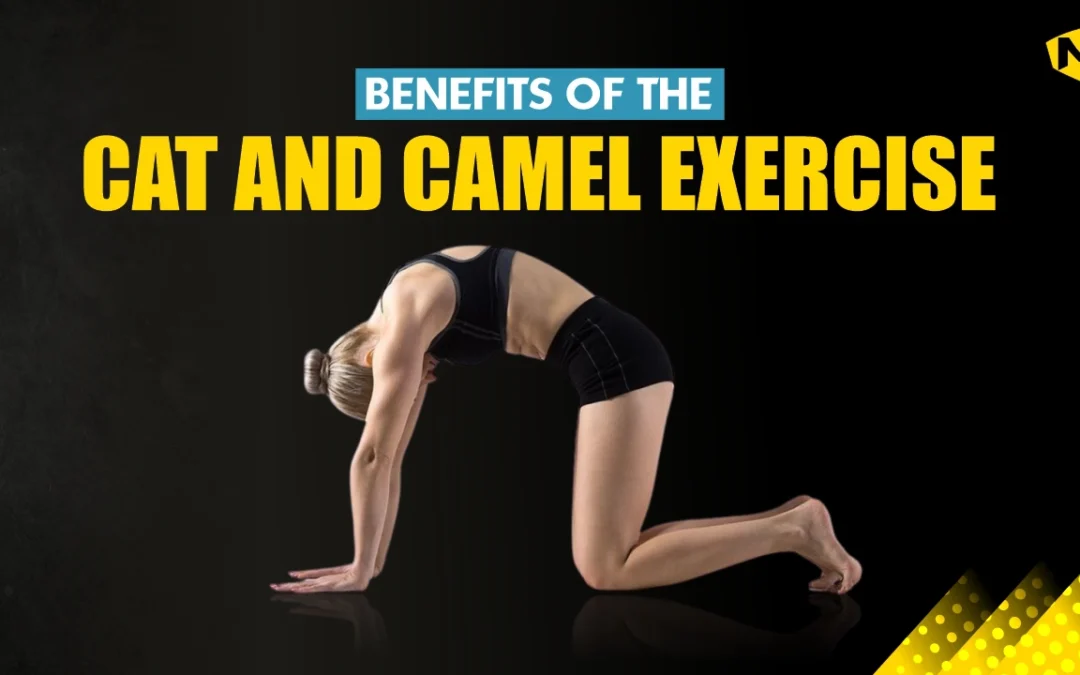
It’s a rhythmic flow where you make an arch with your back (cat pose) and then dip your belly while lifting your head and tailbone (camel pose). You can add this stretch to your fitness routines and warm-ups.
Benefits of the Cat and Camel Exercise
Eases Back Pain and Tension
Many of us spend hours sitting, which can leave with a stiff and sore back. The cat and camel stretch helps to release that built-up tension by extending your spine. It gives you relief for your lower back and mid-back.
Improves Spinal Flexibility
Regularly practicing the exercise keeps your spine flexible. There are also many other simple yoga poses to help in posture like Baddha Padmasana and Vajrasana.
Boosts Circulation
The rhythmic motion improves blood flow to the spinal discs and muscles. Better circulation means your body is healing and recovering faster, making you feel energized.
Promotes Relaxation
With a proper breathing form, you can calm your mind and body. It’s a great way to relax after a long day or prepare for a good sleep.
Strengthens Core and Stabilizing Muscles
It’s a gentle exercise, but with that you also engage your core muscles. This helps you have a better posture and balance over time.
How to Perform the Cat and Camel Exercise?
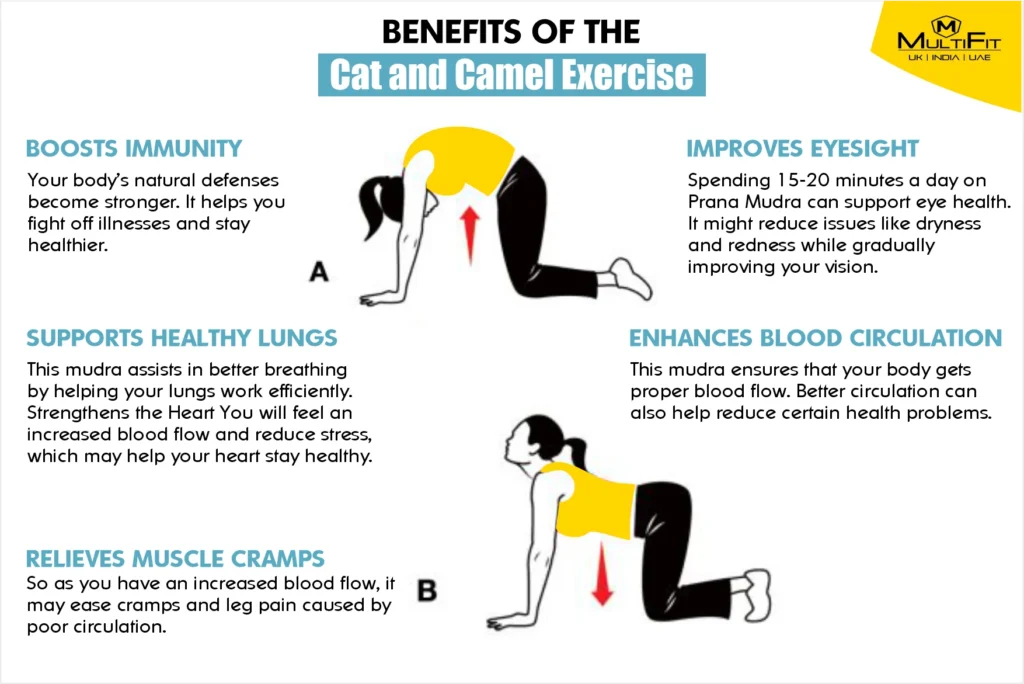
1. Come to your hands and knees, keeping your hands under your shoulders, your knees under your hips, and your back in a neutral position.
2. Cat: With your tailbone sticking out, bend your spine so that it curves with your back, and simultaneously lift your head and lower it toward the floor. Take a big breath out at the same time.
3. Camel: To make a camel hump, tuck your head and tailbone in and arch your back. Take a big breath in at the same time.
When to Use the Cat and Camel Stretch
The cat and camel exercise is versatile and can fit into various parts of your day. Try it:
– First Thing in the Morning: Wake up your body and ease stiffness.
– Before or After Workouts: Use it as a warm-up or cool-down to keep your spine happy.
– During Breaks: Spend a few minutes stretching during a long day of sitting to recharge.
– As Part of Yoga Practice: Combine it with other poses for a complete routine.
Final Thoughts
The cat and camel exercise is more than just a stretch.
It helps you to feel less stress, and also have a healthier spine.
This blog is aimed to help you improve flexibility and also to show how this relaxing stretch offers. Doing joint-function training, group dynamics, HIIT, or endurance training can help you even further; Mind, Body and Soul.
FAQ’s
Can beginners do the cat and camel exercise?
Absolutely! It’s a low-impact stretch for anyone willing to try. Start slow, and listen to your body.
How often should I do the cat and camel stretch?
Do 1-2 times daily or whenever your back feels tight. Consistency is key.
Is it the same as the cat-cow stretch?
The terms cat-cow and cat and camel, they are actually the same. They refer to the same movement, combining the cat pose and the camel pose.
Can it help with posture?
Yes! The cat and camel exercise strengthens stabilizing muscles, which can improve posture over time.
by indigiseo | Mar 5, 2026 | Blog
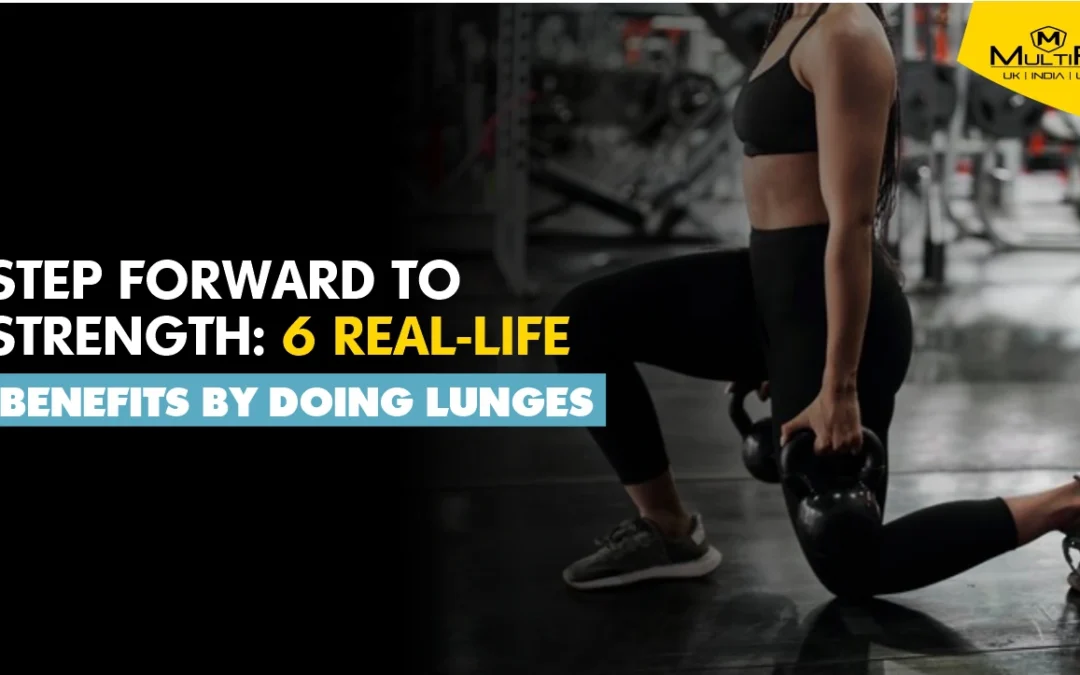
Step Forward to Strength: 6 Real-Life Benefits by doing Lunges
Experience difficulty when you attempt to climb stairs or raise objects from the floor?
Your daily routines require both strength and balance together with proper body coordination.
The addition of lunges to your workout routine enables better performance of everyday physical activities. This easy exercise provides major advantages which lead to improved daily performance and total fitness capabilities.
What Are Lunges?
Before exploring the lunges exercise benefits, let’s understand what are lunges.
Lunges consist of moving your lower body by stepping to different directions while bending knees to decrease your body position. The exercise duplicates regular movements such as stair-climbing and walking due to its functional nature.
Lunges Meaning in Fitness
Lunges meaning refers to a compound exercise which activates several muscle groups during one performance.
Lunges operate on each body half independently to fix strength gaps between sides and boost neuromotor coordination.
Lunges Exercise Benefits
Let’s see how the lunges exercise benefits us:
- Strengthens Lower Body Muscles: Muscle endurance and strength of quadriceps, hamstrings, glutes and calves improves through lunges.
- Improves Balance and Stability: Lunge exercises develop both proprioceptive abilities and coordination because exercises focus on each leg independently.
- Enhances Core Strength: Proper exercise form enables your core to engage which leads to better overall stability.
- Increases Flexibility: Performing lunges activates the hip flexor muscles and improves joint movement capabilities.
- Boosts Functional Fitness: Lunges help to maintain functionality by replicating natural human motions which strengthen the body in every aspect
- Supports Weight Management: Performing lunges as a combined exercise helps people shed calories and maintain their weight.
Lunges Exercise Muscles Worked
Let’s understanding the lunges exercise muscles worked:
Quadriceps:
Four muscle groups (rectus femoris along with vastus lateralis and vastus medialis and vastus intermedius) comprising the quadriceps exist at the front side of thigh tissues which people call the quads.
These muscles hold fundamental value for our routine movements including walking and stair climbing and standing from chairs and running with special significance during squats and lunges movements. The strength of quadriceps muscles provides both improved lower-body strength and enhanced knee joint stability that reduces the chance of injuries while improving movement stability.
Hamstrings:
The hamstrings include three muscles which exist behind the thigh region.
Biceps femoris and semitendinosus together with semimembranosus form the three muscles of the hamstrings. Bending the knee (knee flexion) stands as the main hamstrings muscle function as they also help extend the hip during movement to move the leg behind the body.
Walking, running, jumping and lunging require strong hamstring muscle action for proper performance. Your hamstrings both control movements while delivering power generation during physical movements.
Gluteus Maximus:
The gluteus maximus represents the biggest and most forceful buttocks muscle. The main function of gluteus maximus includes hip extension while it supports external hip rotation and abduction as well.
This large buttocks muscle enables important actions such as standing up and stair climbing while functioning most prominently during both running movements and squatting exercises and lunges.
When doing lunges the gluteus maximus muscle activates to return your body back to its starting position. A strong gluteal complex accomplishes lower-body motions as well as strengthens your lower back while improving both your posture and stability.
Calves:
Your calves consist principally of two muscles such as gastrocnemius and soleus which act jointly at the lower back of your lower leg. Your calves combine forces to elevate your heel throughout all kinds of foot movements such as walking, running and jumping.
Lunges require the calves to maintain ankle stability and balance when players move their weight between legs.
The strength of your calves enhances general lower body strength and defends your ankles from injury and supports quick and precise movements in sprinting and altering directions.
Core Muscles:
Multiple muscles in the anterior regions of the body make up the core muscles which include abdominals together with obliques as well as lower back and hip muscles. Together all these muscles form a complete unit that enables body stability and helps support our posture while protecting the spine.
Core muscles consist of rectus abdominis together with obliques as well as transverse abdominis combined with erector spinae and hip flexors. Strong core activation occurs during lunges since it helps you keep balance and sustain proper posture. A robust core body system provides both better physical stability and enhanced athletic potency and protects the lower back from possible injuries.
Types of Lunges Exercise
Let’s explore various types of lunges exercise:
- Forward Lunges: The exercise focuses on the quad and glute muscles when moving in this direction.
- Reverse Lunges: When stepping backward one can reduce knee strain.
- Walking Lunges: A forward movement pattern enables growth of balance and coordination performance.
- Side Lunges: Sidelong stepping performs inner thigh work and enhances movement in all directions
- Curtsy Lunges: When you cross a leg backward it activates both glutes and inner thighs.
- Jumping Lunges: The plyometric portion elevates both intensity levels and cardiovascular activity while being included.
Lunges Target Muscles
Focusing on lunges target muscles:
Gluteus Medius and Minimus: Stabilize the pelvis during movement.
Adductors: Inner thigh muscles aiding in leg movement toward the body’s midline.
Hip Flexors: Assist in lifting the thigh during the stepping motion.
Erector Spinae: Back muscles maintaining an upright posture.
Conclusion
Lunges as part of your fitness training improve your strength and balance alongside better overall body performance.
The exercise enables your body to become ready for routine daily activities so you can handle tasks like stair-climbing and object handling. Begin implementing lunges right now for immediate experience of their beneficial effects.
FAQ’s
How often should I do lunges?
Incorporate lunges into your workout 2-3 times a week, allowing rest days for recovery.
Can beginners perform lunges?
Yes, start with bodyweight lunges, focusing on form before adding resistance.
Are lunges suitable for people with knee issues?
Reverse lunges are gentler on the knees. Consult a healthcare professional before starting any new exercise.
Do lunges help in weight loss?
As a compound exercise, lunges burn calories and can aid in weight management when combined with a balanced diet.
Can lunges be done at home?
Absolutely, lunges require minimal space and no equipment, making them ideal for home workouts.
by indigiseo | Mar 4, 2026 | Blog
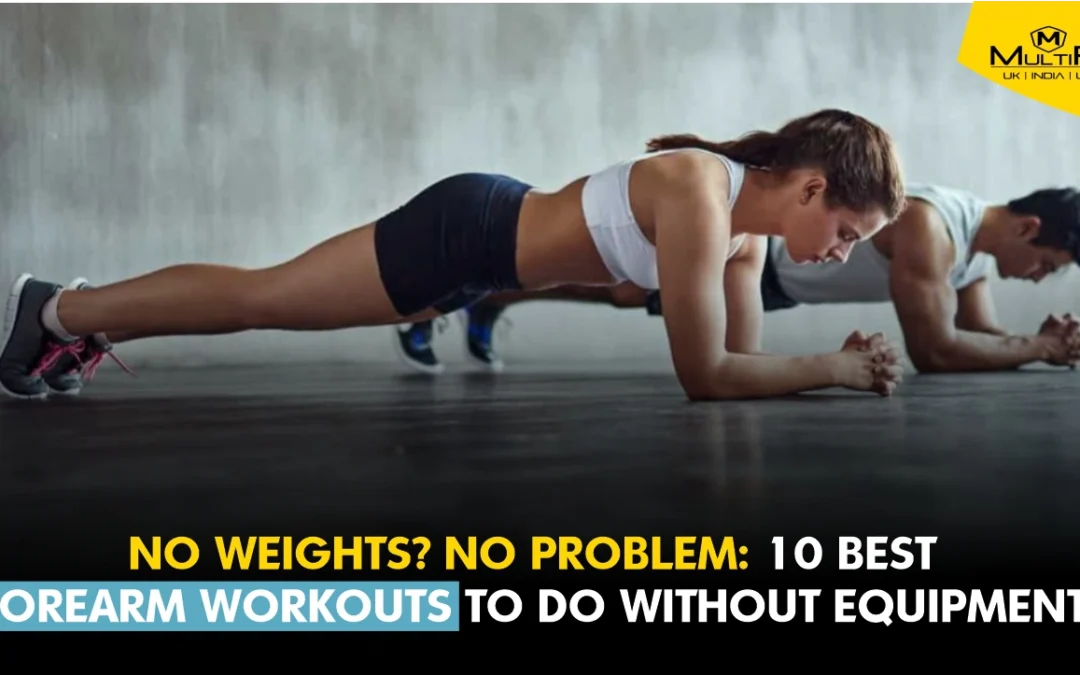
No Weights? No Problem: 10 Best Forearm Workouts to do Without Equipment
Imagine opening a jar that doesn’t want to budge or carrying many little grocery bags and your arms let go first, not your hands.
Efficient forearms benefit athletes as well as the everyday person. Fortunately, there’s some good news ahead.
You don’t have to go to the gym or use fancy machines to build your muscles.
This guide on forearm workout without equipment, you’ll learn how to enhance your grip and forearm muscles at home with just bodyweight exercises.
Why Focus on Forearms?
Forearms are important for almost all kinds of upper body exercise.
Being strong in the forearms makes everything easier and safer, whether you are typing, lifting or cooking.
A focused forearm workout also helps your arms look more attractive.
Top Forearm Exercises Without Equipment
Let’s delve into exercises that require no equipment but offer maximum benefits.
1. Reverse Hand Push-ups
This variation targets the forearms intensely.
How to Do It:
Assume a kneeling position.
Put your hands onto the floor, with your fingers pointing to your knees.
Extend your legs to plank position.
Lower down with your elbows bent and push up.
This exercise is a staple in forearms exercises for gym routines and is equally effective at home.
2. Wrist Rotations
This exercise will add wrist flexibility and as well as strengthen the forearms.
How to Do It:
Stand with your arms extended in front of you.
Rotate wrists clockwise for 30 seconds.
Repeat counterclockwise.
At best planned into a forearm workout sometime, this can yield significant results.
3. Static Hold Plank
This exercise will recruit all of your forearms and pair core values.
How to Do It:
Assume a forearms plank position..
Create a straight line from head to heels.
Hold for 30-60 seconds.
A fundamental move in any forearm workout without equipment regimen.
4. Knuckle Push-ups
This knuckle push-up will help build strength in your wrists and forearm.
How to Do It:
Assume the push up position and support your weight on your knuckles.
Lower your weight and push-up.
This is often seen in forearms exercises gym settings but can be done anywhere.
5. Arm Scissors
This exercise will help improve venous circulation and the forearm’s endurance.
How to Do It:
Stand up and extend your arms to the sides.
Cross your arms in front of your chest and return.
Repeat rapidly for 30 seconds.
This exercise will fit perfectly into your best home exercise for forearms.
6. Fingertip Plank
This exercise will improve grip strength and increase endurance in fingers.
How to Do It:
Assume a plank position and support your weight on your fingertips.
Hold for as long as you can.
A challenging yet rewarding forearm workout best exercise.
7. Forearm Squeeze
This exercise will sufficiently target your forearm flexors.
How to Do It:
Squeeze a soft object, such as a towel, or tennis ball.
Hold for 5 seconds, then release.
Repeat for 15 reps.
Simple yet potent for your best home exercise for forearms routine.
8. Crab Walk
Engages multiple muscle groups, including forearms.
How to Do It:
Sit on the floor, hands behind you, fingers pointing forward.
Lift your hips and walk forward and backward.
A dynamic move in forearms exercises gym programs, adaptable for home workouts.
9. Isometric Wall Push
Builds static strength in forearms.
How to Do It:
Stand facing a wall, arms extended.
Push against the wall with maximum effort.
Hold for 30 seconds.
Incorporate this into your forearm workout without equipment plan for variety.
10. Cherry Picker
A dynamic movement targeting forearm flexors.
How to Do It:
Stand with feet shoulder-width apart.
Extend arms overhead and mimic picking cherries.
Repeat for 1 minute.
A fun and effective best home exercise for forearms.
Structuring Your Forearm Workout
Maximize your benefits by doing a forearm workout without equipment as below:
- Easy Cardio: Begin by doing a few minutes of light running or circle your arms for 5 minutes.
- Pick several of the exercises listed, do 2 sets of 10-15 repetitions each time.
- After swinging your arms, pause from hitting and stretch your forearms and wrists.
Being regular helps a lot. Train your forearms every 2-3 days, so you get a rest from them in between.
Conclusion
You don’t require any special equipment to build your forearm muscles.
Maintaining your workout routine and these exercises can give you good results at home.
The best way to work your forearms is by doing the same exercise again and again. You’ll immediately notice a positive change in your feelings if you take action now.
FAQ’s
How often should I do forearm workouts?
Physically stimulate your muscles about 2 or 3 times per week and, at least once per week, allow yourself a pause to recover.
Can I do these exercises every day?
Some movements, like turning your wrists, can be done every day, though you shouldn’t forget to rest your muscles
How long will it take to see results?
With consistent effort, you can see the changes in your body in 4-6 weeks.
Will these exercises improve my grip strength?
Yes. Many of the exercises help build your grip which is good for your everyday activities.