by indigiseo | Mar 8, 2026 | Health
7-Day Summer Fat Loss Plan: Simple Steps to Get Fit and Feel Great
Summer has arrived which motivates people to become confident and energized. Many people right now feel unrestrained in their clothing because of their low energy levels.
A properly designed program will enable you to begin feeling better after one week. A 7-day summer fat loss exercise plan has been created to suit different lifestyles and it delivers scientific results while maintaining practical usage.
Join me in our journey in this 7 day summer fat loss plan to have the healthiest summer season you have experienced thus far.
Day 1: Morning Walks and Mindful Eating
Each morning, start with a 30-minute brisk walking.
Walking during early morning increases fat metabolism to a level 70% higher than walking after eating breakfast. Your food choices should consist of whole food items which include vegetables together with lean proteins and whole grains.
You should eliminate processed foods together with sugary drinks from your diet.
Day 2: Strength Training Basics
The workout routine should include bodyweight moves such as squats and push-ups combined with lunges for a total of three sets with twelve repetitions in each set.
Each exercise should include three sets with twelve repetitions.
The practice of strength training acts as both a metabolism booster and a fat loss generating method. Stick to your morning exercises along with your current healthful diet strategies.
Day 3: High-Intensity Interval Training (HIIT)
Perform a 20-minute duration HIIT workout consisting of thirty-second increment periods between maximum-intensity movements and recovery.
Repeat for 20 minutes. HIIT proves more efficient than combining moderate exercise with continuous training when targeting fat reduction in the body. You need to eat food that is balanced to give you energy for exercise.
Day 4: Rest and Recovery
Rest is crucial.
Perform stretching or practice yoga as gentle activities after long periods of rest. Your body uses proper sleep to control hunger hormones which aids in fat loss. The recommended amount of quality sleep should be between 7 and 8 hours. Maintain your healthy eating habits.
Day 5: Pool Workouts
Teams should do water aerobics or swim if accessibility permits them.
Exercise in water supports weight reduction and provides joint-friendly activities. Follow your regular balanced eating plan together with adequate hydration
Day 6: Combine Cardio and Strength
You should perform five-minutes of cardio activities followed by 5-minutes of strength exercises. This combination maximizes calorie burn. Eat meals that contain wholesome balance between foods.
Day 7: Reflection and Planning
Take a rest day. Wise reflection of your achievements will guide your strategic planning for upcoming weeks.
Consistency is key. In order to stay on course you should prepare your meals ahead of time along with scheduling your workout times.
Conclusion
This seven-day summer fat loss exercise schedule leads you toward health improvement.
Both simple exercises and mindful eating help your routine so you can achieve higher energy levels and greater confidence. Your commitment to wellness continues indefinitely and your every beneficial decision adds to your progress.
Healthful living needs to be the focus of this summer period in order to build vitality.
FAQ’s
Can I adjust the plan to fit my schedule?
Absolutely. The plan provides flexibility so users can customize it according to their schedule and individual choice.
What if I miss a day?
Don’t worry. You can easily start from the point where you had stopped. Consistency over time yields results.
Do I need any special equipment?
No. Most exercises use body weight. Dumbbells along with resistance bands are optional gym equipment that users can utilize to boost their workouts.
How important is diet in this plan?
Diet plays a significant role. Your results from exercise and healthy eating combinations become stronger when used together to minimize body fat.
by indigiseo | Mar 8, 2026 | Blog, Health
Your Guide to Front Press: How to Do It, Benefits, Variations, and Safety Tips
Ever heard of the Front Press?
It is also known as the Front Military Press. It is a compound exercise where you target your shoulder muscles, i.e. your deltoids. It’s also a variation of the overhead press, so you push weights from the front of your body instead from the sides.
In this blog, let’s understand what Front Press is all about, its benefits and variations, safety guidelines, and learn a step-by-step guide on how to perform it.
What is the Front Press?
The front press is a strength training exercise. You lift a weight of your comfort, be it a dumbbell or barbell, and push it from the front of your body to overhead. This exercise makes sure that the joints and several muscle groups work at once.
The main muscles focused here are the deltoids, trapezius, and triceps.
How to Do the Front Press?
Here’s how to perform the front press safely and effectively:
- Stand with your feet shoulder-width apart. Your toes should be facing forward or slightly outward.
- Hold the weight at shoulder height. Your hands should be on your shoulder level, width apart, and your palms facing forward.
- Push the weight straight up over your head, fully extending your arms.
- And then, lower the weight back down to the starting position steadily in motion.
- Repeat this exercise (3 sets of 10-15 reps is a good start).
[Disclaimer: Do consult and take guidance from a certified trainer before beginning any exercise program.]
Benefits of the Front Press
Why should you include the front press in your workout routine?
Here are a few reasons:
Improved shoulder front press strength and development: Your deltoids, trapezius, and triceps are being targeted. This helps to build strong and broad shoulders.
Overall Strength: You are engaging multiple muscle groups. This leads to overall strength gains.
Improved Athletic Performance: You can boost your performance in sports. Especially sports with overhead movements, like basketball, volleyball, and tennis.
Better Posture: Here, when you build a broader shoulder, you improve your posture as your shoulders are pulled back, which opens up your chest.
Variations of the Front Press
There are other variations to target these muscles so you can keep your workouts interesting:
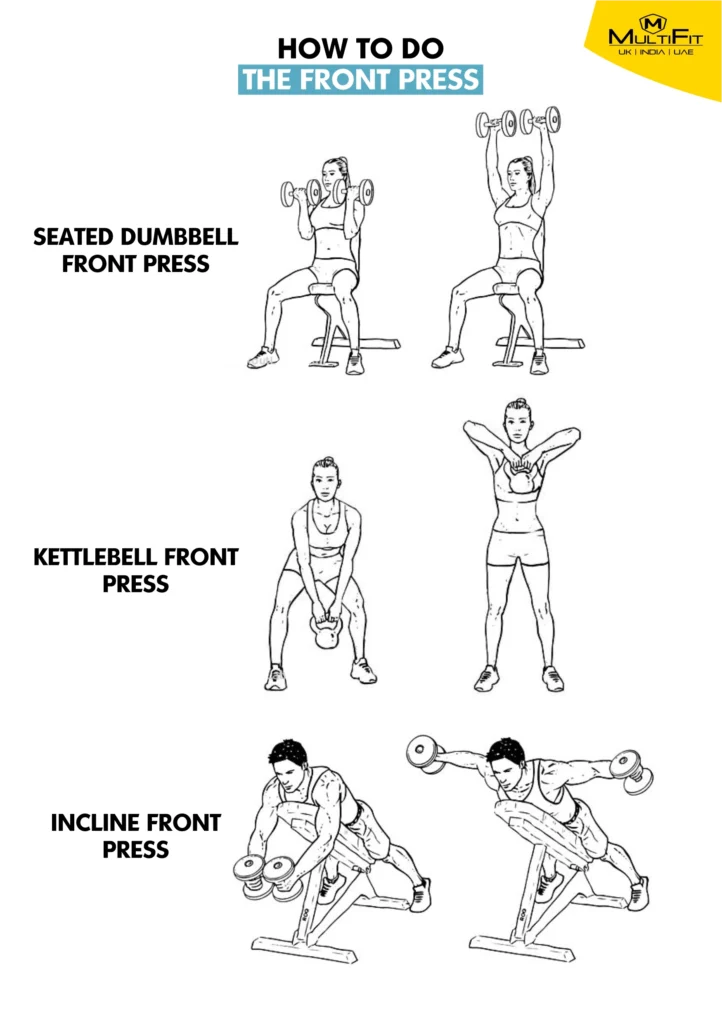
- Seated Dumbbell Front Press: While seated, use dumbbells so you can target your shoulders from a different angle.
- Kettlebell Front Press: With kettlebells, your core muscles play an important role. Here, your core muscles help in creating stability while doing the exercise.
- Incline Front Press: Perform the front press on an incline bench; your muscles targeted will be the upper chest, shoulders, and triceps.
Safety Tips
To make sure your workout is done in a proper manner, keep these in mind:
- Warm Up: Always do a proper warm-up for your shoulders and upper body with light cardio and stretching.
- Maintain Proper Form: With good form, you can avoid future injuries. I would definitely recommend having a trainer or head coach while performing the exercise.
- Start Light: Begin with a weight you can handle while maintaining good form. Slowly increase the weight as you get stronger.
- Avoid Arching Your Back: Keep your back straight, and you can prevent injury.
Conclusion
The front press is an exercise that can help you build stronger, broader shoulders.
You also boost your athletic performance and improve your overall health. By following this guide and working with different variations while prioritizing your safety, you can make the most of this exercise and achieve your fitness goals.
FAQ’s
What is the Front Press good for?
The front press helps build strong, broad shoulders, improves overall strength, enhances athletic performance, and promotes better posture.
Can I do a front press with dumbbells?
Absolutely! Using dumbbells can offer a different angle and variety to your routine.
Is the front press suitable for beginners?
It can be challenging. However, with the right guidance and practice, anyone can learn to perform the front press safely and effectively.
by indigiseo | Mar 5, 2026 | Health
Introduction
You might be hearing the term functional training very often in the world of fitness. It may sound fancy, but it’s basically getting fit for real life. You know that struggle of lugging groceries or hoisting yourself off the couch? Functional training is your superhero’s origin story for everyday tasks.
Instead of just pumping iron, you’ll be doing exercises that mimic your daily movements. Think squats for getting up and down easily, lunges for grocery runs, and pushes and pulls for, well, pushing and pulling things! It’s all about building strength, mobility, and power that translate from the gym to your everyday life.
But the benefits go beyond the physical. Functional training can leave you feeling like a total boss – conquering that to-do list with newfound energy. Plus, there’s a mental boost that comes from feeling strong and capable. It’s a win for your body, mind, and soul.
Functional training also helps in better:
- Flexibility
- Balance
- Endurance
In recent years, people all around the world have focused on functional exercises. The reason? Who doesn’t want to be strong and flexible in everyday life?
How Functional Training has Evolved?
Functional training has more tools now. Basics like medicine balls and dumbells are still used. However, there are new options:
- Slosh Pipes,
- Battle Ropes,
- Sandbags,
- Kettlebells
- Suspension Trainers
But can it be done at home? How much time does it take to see the results? Functional exercises can easily be done at home with minimal equipment. Exercises like squats, planks, step-downs, and step-ups need to be done five to six times a week to gain optimal results.
Benefits of Functional Training
Functional training is all about moving your body efficiently. Instead of just working on single muscles, it focuses on multiple muscle groups simultaneously. Some functional fitness benefits are mentioned below:
1. Better movements: Functional training is synonymous with doing exercises that emulate ordinary daily movements, such as bending down, lifting from the floor, pushing, pulling, and head rotations. This helps you move better in everyday activities.
2. Improved performance: Athletes use functional training to excel in their sports. It helps them move more effectively and efficiently during competitions.
3. Toned body: By engaging multiple muscles together, you can develop a leaner and more athletic physique.
4. Enhanced coordination: These interactive exercises help maintain coordination and mobility, leading to lesser traumas of the body.
5. Burns more calories: The extra amount of effort and muscle usemakes this form of workout more calorie-burning.
Top 5 Functional Fitness Exercises for Beginners
Some of the functional fitness exercises for beginners are mentioned below:
1. Squat: Squat is like sitting on a chair and then getting up. It’s a must-exercise for beginners to get into functional fitness.
2. Plank: Planking is great for mobility, balance, and strength. It requires all your muscle strength.
3. Row: Rowing is like pulling a heavy object out of your trunk, and it’s great for your back and arms.
4. Single-leg lift: The single-leg lift is all about boosting your balance, which can make everyday activities like walking easier and help prevent falls.
5. Downward-facing dog: The downward-facing dog yoga pose is fantastic for building strength to support your body weight.
Functional Fitness Equipment You Can Start With
If you are thinking that you need thousands of gym equipment to start functional training that’s not the case. You can start with simple yet best functional fitness equipment. Here are some of the fun beginner tools you can try.
1. Jump rope
2. Elastic bands
3. Pull-up bar
4. Dumbbells
Functional Fitness Training Programs by MultiFit
MultiFit provides a full-fledged Functional Fitness Training Program aimed at generating all-round strength, suppleness, movability, and flexibility. Such programs custom-fit people of all levels, from beginners to Olympic athletes.
1. Movement Checkup: Before starting, we check how well you move to see what needs improvement.
2. Tailored Exercises: Your trainer makes a special plan based on what we found, with exercises like squats, lunges, pushing, pulling, and turning.
3. Equipment Options: We have lots of tools to help, like bands, weights, balls, and more, for a great workout.
4. Expert Guidance: Seasoned trainers are in place to guide participants with appropriate form, technique, and progression to facilitate safe and successful workouts.
5. Progress Tracking: Continual evaluations and progress tracking let you follow the gains in strength, flexibility, and fitness level all around.
6. Group Classes and Individual Training: MultiFit provides both group functional fitness training programs, creating a vibrant workout atmosphere, and private fitness coaching sessions centered on individual planning and goal setting.
7. Nutritional Guidance: Alongside exercise workouts, MultiFit also provides nutritional guides that support individual health and fitness goals.
Conclusion
At MultiFit, we provide a complete fitness solution with a combination of functional training, skilled coaching, and personalized programs. MultiFit features cutting-edge equipment and knowledgeable trainers and thus helps people succeed with their fitness objectives.
Join MultiFit now, and you will see a real difference in your fitness journey!
Frequently Asked Questions
1. What is functional training, and why is it important?
Functional fitness training programs include exercises that imitate daily movements, like bending and lifting, and they are crucial because they help you do everyday tasks more effortlessly.
2. Are functional training and HIIT the same?
High-intensity interval Training (HIIT) is characterized by short bursts of intense activity followed by periods of rest or low-intensity exercise for recovery. Functional Training, on the other hand, involves constantly varied functional exercises and different activity durations. The focus of functional training is on performing functional movements that mimic everyday tasks, with the intensity and duration of the exercises varying to keep the body challenged.
by indigiseo | Mar 5, 2026 | Health
Strengthen Your Back and Improve Posture with Bent Over Rows Using Dumbbells
Do you slouch forward after hours of sitting with your head bowed over a desk or a phone?
The prolonged stay in this position can irritate your body and injure your health in future.
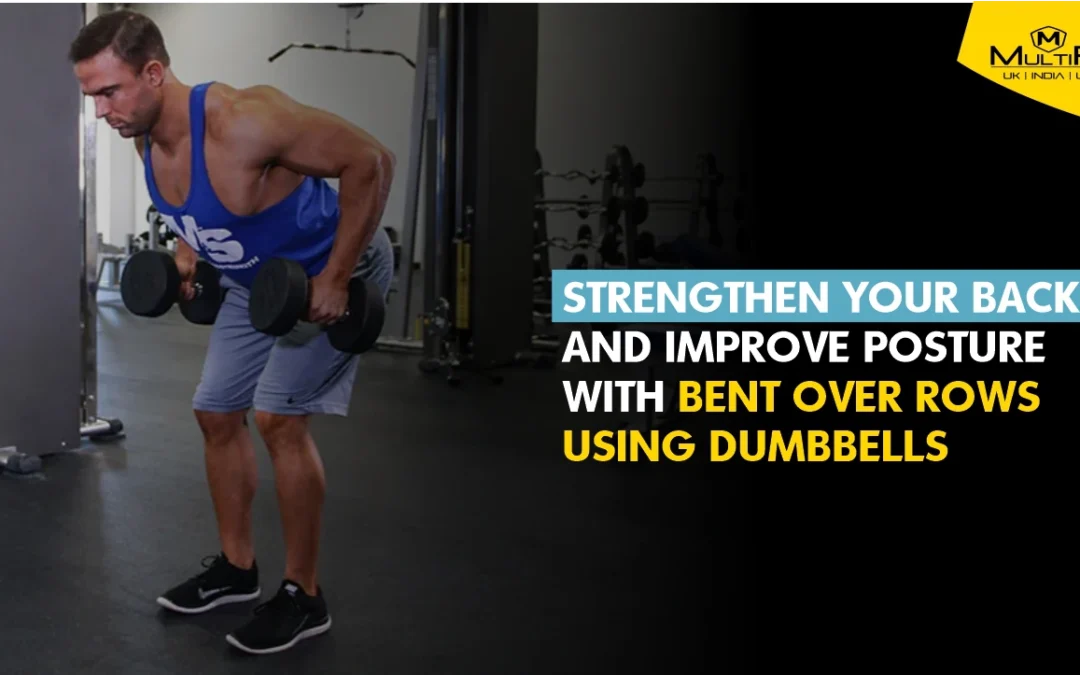
Bent-over rows with dumbbells in the fitness program may be helpful because your back muscles will be stronger and you will stay upright when you sit and stand. If you are new to working out or wish to intensify the workouts, you can see how bent over rows can significantly influence your well-being.
What Are Bent Over Rows with Dumbbells?
Doing bent over rows with dumbbells works the muscles in your upper and middle back.
Hinging at the hips and pulling the dumbbells close to your body uses many muscles at once, so it’s great for upper body strength.
Muscles Worked
Knowing the basics of dumbbell bent over row will help you benefit more from the exercise. This exercise primarily targets:
Latissimus Dorsi (Lats): Your large back muscles are used for pulling and also give your torso a V-shape.
Rhomboids: Lying between the shoulder blades, they help in pulling the shoulder blades down, which boosts posture.
Trapezius (Middle and Lower): They are important for keeping your scapulae steady and your back erect. But if you want to focus on this specifically, the front press can definitely help.
Posterior Deltoids: Your shoulders are better supported because the back of the deltoids keep the joints stable.
Biceps: When you pull, they help to make your arms stronger.
Forearms: When you hold the dumbbells, your grip improves.
Furthermore, the core supports your body during the exercise, which builds up strength and balance.
Benefits of Bent Over Dumbbell Rows
1. Improved Posture
Doing bent over dumbbell rowing regularly increases the strength of your posture muscles, helping to reverse harm from too much sitting or using screens.
2. Enhanced Upper Body Strength
Working on this exercise increases the strength of your back, shoulders, and arms, helping you perform well in day-to-day life and other exercises.
3. Core Stability
Incorporating core engagement as you lift increases your balance and helps you avoid lower back problems.
4. Functional Fitness
Doing this exercise that resembles daily pulling makes everyday tasks, like lifting, easier and safer to perform.
5. Versatility
Bent over dumbbell rowing is flexible, so it works for all fitness routines and can easily be changed depending on your goals.
Proper Dumbbell Row Posture
Your dumbbell row posture is important in two folds in getting maximum results and safety.
Follow these steps:
- Starting Position: Stand with the feet hip-width apart holding dumbbells in your both hands.
- Hinge at the Hips: Bend your upper body forward with the hips while keeping your back straight and your core tight so that you can form a 45-degree angle.
- Arm Position: Hold your arms downwards in such a way that your palms should be facing each other.
- Rowing Motion: Bring up the weights near to the waist while squeezing your shoulder blades together at the top.
- Controlled Descent: Lower the dumbbells slowly and keep under control as you go back to the starting position.
Do not incline your back or even swing your body because in case you get injured you will not obtain good results.
Variations to Try
To keep your workouts engaging and target muscles differently, consider these variations:
Single-Arm Row: Focuses on one side at a time, helping to correct muscle imbalances.
Supported Row: Place one knee and hand on a bench for added stability, reducing strain on the lower back.
Incline Row: Lie face down on an incline bench and perform the row, emphasizing the upper back muscles.
Are Bent Over Dumbbell Rows Good?
Absolutely.
The bent over rows with dumbbells program will provide you with various benefits such as good posture and greater strength of the upper body as well as better core stability. Their wide range of applicability as well as efficiency is an excellent exercise for even all people of the different fitness levels.
Conclusion:
By including a set of bent over rows with dumbbells into your fitness program, you will seriously advance your posture and make your upper body and core stable.
This simple and results-oriented practice eliminates such familiar troubles with sedentary lifestyles as difficulty of daily routine and injury, therefore. Through learning correct form and by progressively stepping up intensity, you will see the marked differences in your physical body health.
by indigiseo | Mar 5, 2026 | Health
Know Your Number: How to Calculate BMI for Men and Women the Right Way
Have you ever looked at a health chart and ask yourself whether you are within the right range?
Perhaps you find yourself asking the question, “Am I healthy?”, after a holiday meal or when planning a fitness plan.
Understanding how to calculate BMI for men and women can provide the answer to that.
It is something straightforward that anyone can apply at home. You stand on a scale, you measure your height and you use a formula.
This small exercise can guide your health decisions. If you are about to embark on an exercise regime or you are simply inquisitive, knowing your BMI will give you a sense of clarity on where you are.
What Is Body Mass Index BMI Test and why Check Your BMI?
The (Body Mass Index) BMI test is the full form of the test that is used to refer to the simple ratio of height and weight to determine whether a person is underweight, normal, overweight, or obese.
- It employs kilograms and meters (or pounds and inches)
- No fancy equipment-just height, weight and a calculator
- Provides a brief overview of health
That’s why it’s so popular. It doesn’t need lab visits or complex methods.
So, why is it necessary to check your BMI:
- It assists in knowing the levels of health risks
- It tells whether you carry unnecessary body fat
- It is a weight goal guide such as bmi calculator to reduce weight
- You do it yourself at home, it is easy
Having your number can assist you in developing a workable plan.
How to Calculate BMI Men – Step by Step
Let’s go through bmi, how does it work out for men. It is almost the same for women.
Metric Method
Formulae: BMI = Weight (kg) / Height (m)²
- Step on a scale to get weight in kg.
- Stand straight and measure height in meters.
- Square your height (height × height).
- Divide weight by that squared height.
Example: If a man weighs 80 kg and is 1.80 m tall:
1.80 × 1.80 = 3.24
80 ÷ 3.24 ≈ 24.7
His BMI is 24.7.
Imperial Method
Formulae: BMI = [Weight (lb) / Height (in)²] × 703
- Get weight in pounds (lb) and height in inches (in).
- Square height (inches × inches).
- Multiply weight by 703.
- Divide by squared height.
Example: 175 lb and 70 in height:
70 × 70 = 4900
175 × 703 = 123,025
123,025 ÷ 4900 ≈ 25.1
BMI is about 25.1.
Calculate BMI Women – Is It Any Different?
The process is identical.
The same formula works for both men and women.
- Measure weight and height
- Apply formula
- Get the result
Your gender doesn’t change the math. But it may influence interpretation. A woman’s body fat distribution differs, so health professionals look at numbers a bit differently.
BMI Categories and What They Mean
When you get your number, here’s how to read it:
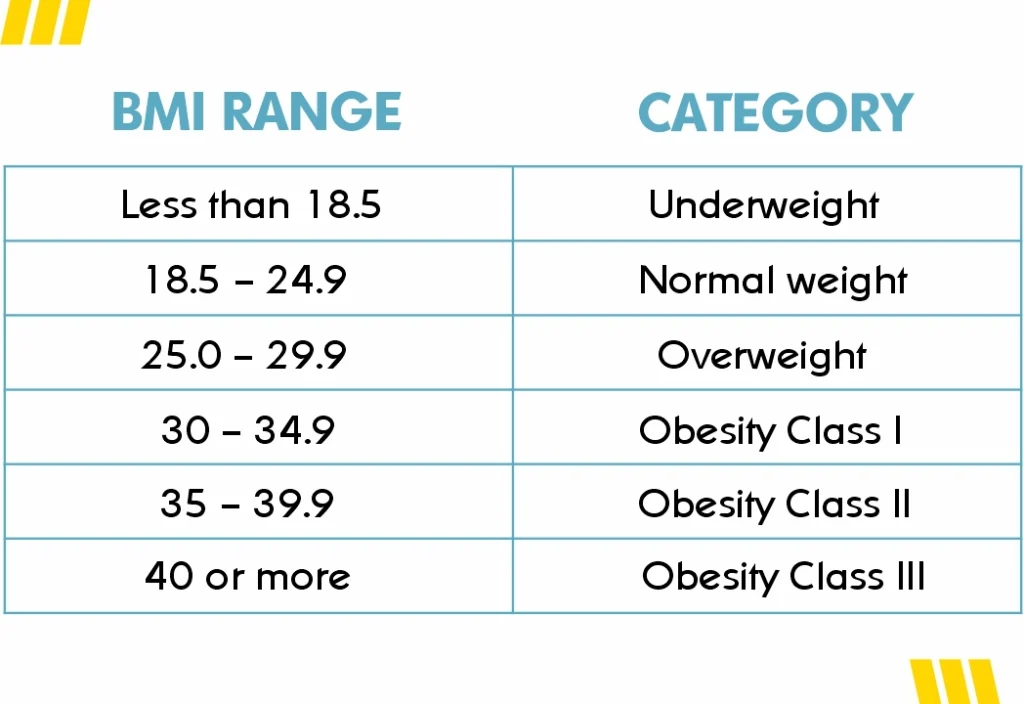
These categories guide your next steps. If you’re in the overweight range or higher, tools like bmi calculator for losing weight could help set safe targets.
Using BMI According to Height
35–39.9
Because BMI adjusts for height, it gives a fair view of body mass across people of different statures.
- A tall person with 80 kg but a BMI of 24.7 is healthy.
- A shorter person with the same weight might land in overweight range.
This is why bmi according to height matters. It normalizes weight.
Pros and Cons of BMI
Pros
Quick and free method
Easy to repeat at home
Helps track health changes
Cons
Doesn’t distinguish muscle from fat
May be misleading for muscular people or the elderly
Doesn’t explore fat distribution (like belly fat)
Understand that BMI is a guide—not the whole picture.
Tips to Use Your BMI Numbers
If you’re aiming to lose weight, try a bmi calculator for losing weight to set safe goals.
Take periodic measurements every few weeks.
Remember, muscle may increase your number without adding fat.
Use other tools too—like waist circumference and fitness levels.
Conclusion
Understanding how to work out bmi men and women can guide you better in life. If your goal is to lose weight, stay fit or you just need to be aware of your position, this is an exercise that provides you with a clear figure.
It can be incorporated into daily life, you just need to step on the weighing scale, measure your height and do the calculations.
In the long run, it turns into a method to observe improvements and adjust your strategy. Try it today. Now, have this easy tool, and you are all set to fine-tune your health, one number at a time.
FAQ’s
Is how to calculate bmi for men the same for women?
Yes. The same formula works for both. Gender doesn’t change math.
What is the bmi test full form?
It stands for Body Mass Index test.
Can BMI predict health risks?
It shows whether you carry extra weight that could raise health risks. It’s part of a bigger picture.
Should I use bmi according to height only?
No. Check waist size, body composition, and how you feel overall too.
How can I get better results using the bmi calculator for losing weight?
Pick healthy targets, combine diet and activity, and track your results over time.
by indigiseo | Mar 4, 2026 | Health
Fueling Your Gains: Discovering the Best Oatmeal for Weight Gain
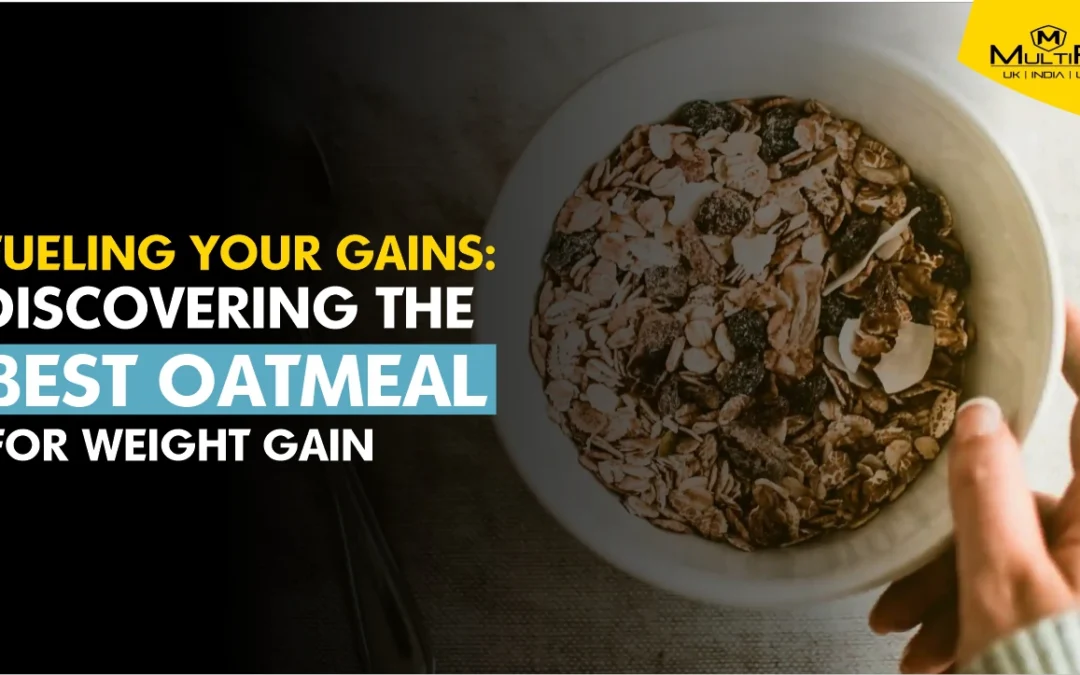
Let’s say that you start each day with a huge bowl of oats as you work towards healthy weight gain.
For many people, healthy weight gain is a hard thing to do even if they could eat any foods they wanted.
Choosing the best type of oatmeal is very simple and will help you put on some pounds. In this blog we will look at what is the best oatmeal for weight gain, and how one basic grain can help you on a healthier path to a fuller body.
Understanding Oatmeal and Its Role in Weight Gain
Oats from which we obtain oatmeal offer versatility and nutrition because they adapt well to promote weight gain.
This food contains complex carbohydrates alongside fiber and essential nutrients which allows it to be the best choice to increase healthy caloric consumption.
Types of Oats and Their Benefits
Rolled Oats:
The quick-cooking breakfast food consists of steamed flattened oats which results in a fast cooking process. The food value remains high in these ingredients alongside their value for an extensive range of recipes.
Steel-Cut Oats:
Whole oat groats that receive chopping treatment create this oat product also known as Irish oats. These oats have a firm texture and need prolonged cooking time to deliver continuous energy over long periods.
Instant Oats:
The oatmeal receives precooking preparation before drying for rapid cooking convenience. Unsweetened varieties present the best option because added sugars should be avoided.
Oat Flour:
This product provides ground oats that bakers can use for dishes while also thickening smoothies and soups allowing people to consume oat nutrition while avoiding whole oat portions.
Enhancing Oatmeal for Weight Gain
To maximize the calorie content of your oatmeal:
- Use Whole Milk: Cooking oats in whole milk instead of water increases calorie and fat content.
- Add Healthy Fats: Incorporate nut butters, nuts, seeds, or coconut oil for added calories and nutrients.
- Include Protein: Mix in Greek yogurt, protein powder, or an egg to boost protein intake.
- Sweeten Naturally: Use honey, maple syrup, mashed bananas, or dried fruits for sweetness and extra calories.
- Top with Extras: Add shredded coconut, dark chocolate, granola, or more nut butter for additional calories and flavor.
Best Oats for Weight Gain in India
Based on nutritional content and availability, here are some top choices:
- Nutriorg Organic Rolled Oats: Provides 12g protein and 350 calories per 100g, rich in antioxidants.
- MuscleBlaze Oats: Offers 22g protein, suitable for muscle gain.
- Disano Oats: Contains 11g protein and 14g fiber, aiding digestion.
- True Elements Oats: Provides 11g protein and 7g fiber, made from whole grains.
Sample High-Calorie Oatmeal Recipe
Ingredients:
- 1 cup rolled oats
- 2 cups whole milk
- 1 tablespoon peanut butter
- 1 tablespoon honey
- ½ banana, sliced
- A handful of chopped nuts (almonds, walnuts)
Instructions:
Cook oats in whole milk over medium heat until creamy.
Stir in peanut butter and honey.
Top with banana slices and chopped nuts.
This combination provides a balanced mix of carbohydrates, protein, and healthy fats, aiding in weight gain.
Conclusion:
A nutritional approach to weight gain can be achieved through dieting with oatmeal.
Your weight gain efforts can benefit from the proper selection of oats in combination with calorie-dense additives that help produce satisfying meals.
A consistent diet with balanced nutrition remains essential to reach after maintaining your preferred weight.
FAQ’s
Can oatmeal alone help me gain weight?
Eating oatmeal which includes whole milk combined with nuts and additional sweetness will lead to increased body weight. Oats need to be included within a multivitamin diet consisting of different nutrient-packed foods.
How often should I eat oatmeal to gain weight?
Oatmeal consumption twice a day at breakfast time or directly after workouts becomes effective for weight gain if people combine it with other weight-gaining meals.
Are flavored instant oats good for weight gain?
Instant oat products that come with flavoring typically include artificial additives together with added sugars. People should select plain oats and include their own natural sweeteners with toppings to establish better control of nutrient and calorie content.
What are some other high-calorie toppings for oatmeal?
You can enhance calorie content by adding dried fruits together with seeds and using full-fat dairy products.