by indigiseo | Mar 4, 2026 | Exercises
Crunch Exercise: Strengthen Your Core with Precision
Does it happen to you that after spending a long time at work, there’s a twinge in your lower back?
Did you notice your posture start to slump as you walked in the evening?
Usually, these small-scale aches show a weak core.
This simple crunch exercise allows you to focus on your core which helps deal with some back pain problems. We’ll discuss what this exercise involves, the correct way to perform it and how it can help you every day.
What Is a Crunch Exercise?
A crunch exercise focuses on strengthening your core by hitting the rectus abdominis which many people want for a six-pack appearance.
Crunches differ from sit-ups because you lift only your upper shoulders and back, keeping the rest of your back pressed firmly.
By isolating your torso, crunches are good for your abs and easy on your lower back.
Benefits of Crunches
Core Strength: Regular exercise crunches work out your core muscles and can give you better posture and pain-free back.
Improved Stability: A strong core improves your ability to balance and coordinate your movements in everyday life.
Accessibility: Anyone can do crunches with little or no equipment and they can fit into your workout anytime, anywhere.
Versatility: Crunches can be easily changed to meet the needs of people who are just starting out as well as those who are experienced.
How to Do a Proper Crunch Exercise
Learning how to do a proper crunch exercise helps you gain many benefits and avoid injuries.
Starting Position:
Place your back on the floor, bend your knees and rest your flat feet at hip-width distance.
Put your arms across your chest or lightly put your fingertips behind your ears.
Engage your core by pulling your belly button toward your spine.
Execution:
As your head, neck and shoulders lift up off the floor, also lift your abdomen without letting your lower back rise.
Keep your lower back pressed into the floor throughout the movement.
Pause briefly at the top of the movement.
Return:
Breathe in and use control to return your upper body back down to the beginning position.
Tips:
Avoid pulling on your neck with your hands.
Focus on using your abdominal muscles to lift your upper body.
Try to move with careful control so the muscles feel the exercise.
Common Mistakes to Avoid
Neck Strain: Fiddling with your neck could bring you pain or harm your neck. Lightly place your hands on your ears and focus on using your core.
Don’t use Momentum: Rough movements can make you less efficient and raise your risk of injury. Take your time and do crunches one at a time.
Lifting Lower Back: When lifting your lower back, be sure it is against the floor for the best workout.
Holding Breath: Remember, when you’re holding breath, exhale when you come up and breathe in when you head under again.
Variations to Enhance Your Routine
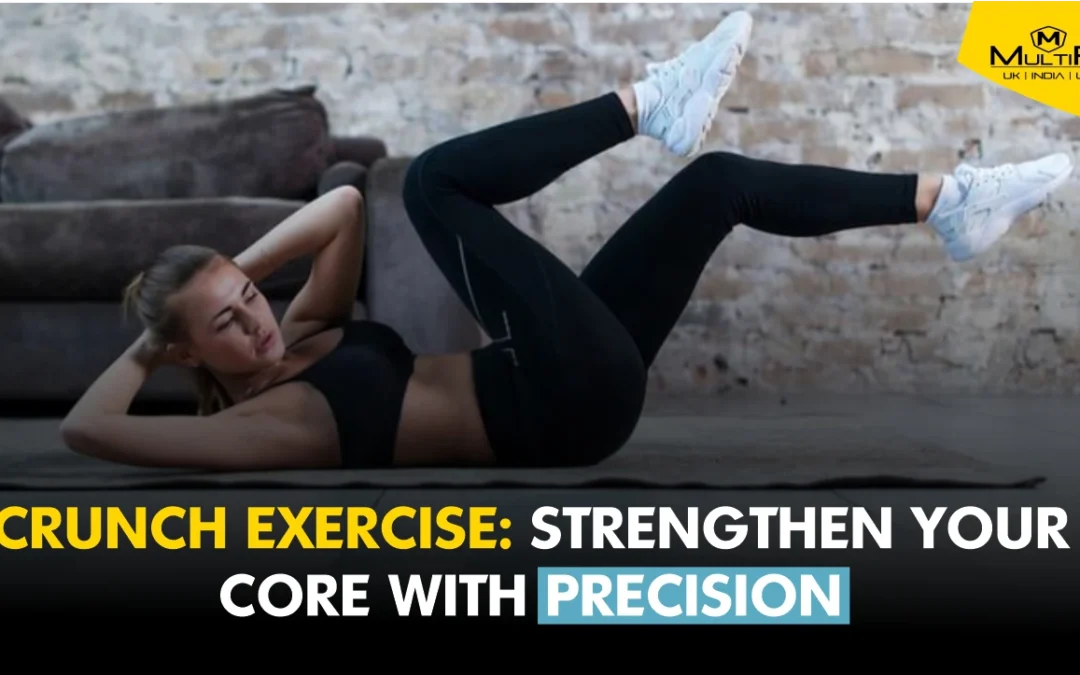
Bicycle Crunches: With Bicycle Crunches, twist your body to the left as you raise your right leg and back to the right as you bend your left leg.
Reverse Crunches: Pay attention to working your lower abdominal muscles by pulling your hips up off the floor.
Stability Ball Crunches: A stability ball is a good way to do crunches, adding flexibility and activating muscles that help keep your body stabilized.
Standing Oblique Crunches: Performing oblique crunches while upright helps tone the waist and makes you feel more balanced.
Crunches into Your Fitness Routine
Frequency: It is good to exercise 2–3 times a week, making sure you have breaks between exercises.
Repetitions: At first, do 2–3 sets of at least 10 repetitions, paying close attention to how you lift weights.
Progression: Move forward by repeating exercises more often or by trying variant options once you become stronger.
Complementary Exercises: For a better workout, try crunches along with planks and leg raises.
Conclusion
Including crunch exercise will strengthen your main muscles and can help your posture and ease your everyday pain.
The health benefits of this exercise are numerous.
Knowing how to do crunches correctly and without errors and sort of managing the way you progress in difficulty is also advantageous to realize through the use of crunches.
Moving and maintaining the same patterns and posture is important to achieving your health and fitness goals.
FAQ’s
How do crunches differ from sit-ups?
Crunches focus on lifting the upper back and shoulders while you strengthen your abdominal muscles. You use your hip flexors in addition to your core muscles when you do a sit-up.
Can crunches help me lose belly fat?
Crunches work the abs but don’t necessarily melt the fat in your belly. You achieve better results for fat loss by combining crunches, cardio and eating healthily.
Are crunches safe for people with back issues?
When done as instructed, crunches are safe to do. Still, those with back problems should get medical advice before beginning any new exercise program.
How often should I do crunches?
Fit in crunches in your workout plan 2–3 times a week, so you don’t overstress your muscles.
What’s the best way to progress with crunches?
While becoming stronger, perform each move several times and think about changing things up for your workouts.
by indigiseo | Mar 4, 2026 | Exercises
Achieving a well-defined core is a common fitness goal, but many need to pay more attention to the importance of a balanced workout routine. While targeting the lower abs is crucial for building a solid core, combining these exercises with full-body workouts can take your fitness to the next level. In this blog, we’ll explore the benefits of integrating lower abs workout with full body exercises, the best exercises to incorporate, and how this combination can help you achieve a well-rounded and powerful physique.
The Importance of Lower Abs Workouts
The lower abs workout plays a crucial role in building a strong and stable core, serving as the foundation for improved posture, balance, and overall body strength. Incorporating these into your routine is essential for achieving a well-rounded, functional fitness level and contributes to a more defined, toned midsection.
Understanding the Lower Abs
The lower abs are part of the rectus abdominis, the muscle that runs vertically along the front of your abdomen. This muscle is responsible for flexing the spine and stabilizing the pelvis. The lower abs, in particular, are often the most challenging to target, but they are essential for maintaining a strong and stable core. Focusing on lower abs workouts can help you build the foundation for core strength.
Benefits of Lower Ab Exercises
Lower ab exercises offer numerous benefits:
- Strengthens Core Stability: Enhances overall core strength, improving balance and posture.
- Improves Athletic Performance: Boosts power and efficiency in activities like running and lifting.
- Supports Lower Back Health: Reduces the risk of lower back pain by stabilizing the spine.
- Enhances Flexibility: Increases mobility in the hips and pelvis, leading to better movement.
- Aids in Functional Movements: A strong lower core facilitates daily tasks like bending and lifting. It also supports the spine and pelvis, which is crucial for maintaining proper alignment during various activities.
- Contributes to Aesthetic Goals: Helps define and tone the lower abdominal area, contributing to a leaner appearance.
- Boosts Metabolism: Engages multiple muscle groups, which can lead to increased calorie burn.
Why Combine Lower Abs Workouts with Full-Body Exercises?
Combining lower abs workout with full-body exercises maximizes the efficiency of your fitness routine. This approach not only strengthens and tones your core but also enhances overall body coordination, and stability. By pairing lower abs exercises with full-body routines, you achieve a more balanced and effective workout, leading to better results in less time.
1. Maximizing Efficiency
Combining lower abs workouts with full body exercises maximizes your workout efficiency. Instead of dedicating separate sessions to lower abs and full-body training, you can integrate both into a single routine. This approach not only saves time but also ensures that your workouts are balanced, addressing multiple muscle groups simultaneously.
2. Enhancing Core Stability
Full-body exercises often engage the core, including the lower abs, as stabilizers. By combining lower abs exercises with full-body movements, you enhance core stability and improve overall body coordination. This integration helps you develop functional strength, leading to better performance in sports and daily activities.
3. Boosting Calorie Burn
When you incorporate full-body movements into your lower abs workout, you increase your session’s intensity and calorie burn. Full body exercises such as squats, deadlifts, and burpees engage large muscle groups, elevating your heart rate and boosting your metabolism. This combination can help you burn more calories and fat, making achieving a lean, toned physique easier.
Effective Lower Abs Exercises
Effective lower abs exercises target the deep core muscles, helping to build strength and definition in the lower abdomen. Incorporating these exercises into your routine can significantly enhance core stability, support lower back health, and contribute to a more toned, sculpted midsection.
1. Leg Raises
Leg raises are a classic lower abs workout that effectively targets the lower portion of the rectus abdominis. Lie flat on your back with your legs extended to perform leg raises. Slowly lift your legs towards the ceiling while keeping them straight. Lower your legs back down without letting them touch the ground, and repeat.
2. Reverse Crunches
Reverse crunches are another excellent exercise for the lower abs. Begin by lying on your back with your knees bent and feet flat on the floor. Lift your hips off the ground while bringing your knees towards your chest. Lower your hips back down slowly and repeat the movement.
3. Mountain Climbers
Mountain climbers are dynamic exercises that engage the lower abs while also providing a cardio boost. Start in a plank position with your hands directly under your shoulders. Drive one knee towards your chest and then quickly switch legs, mimicking a running motion while keeping your core engaged.
Integrating Full-Body Exercises with Lower Abs Workouts
Effective lower abs exercises target the deep core muscles, helping to build strength and definition in the lower abdomen. Incorporating these exercises into your routine can significantly enhance core stability, support lower back health, and contribute to a more toned, sculpted midsection.
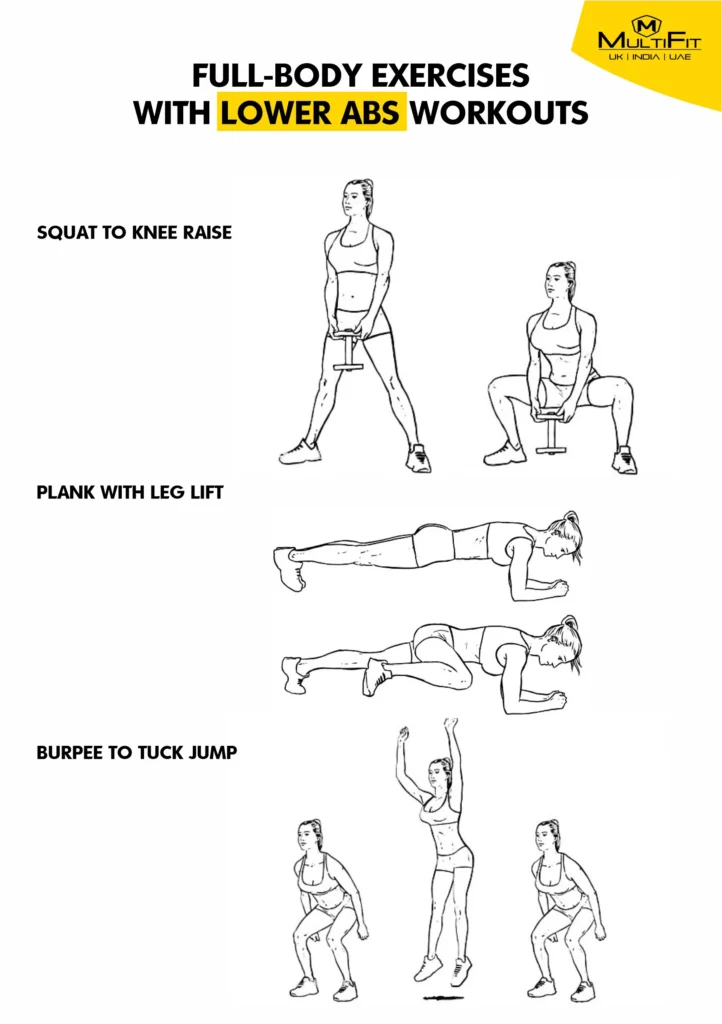
1. Squat to Knee Raise
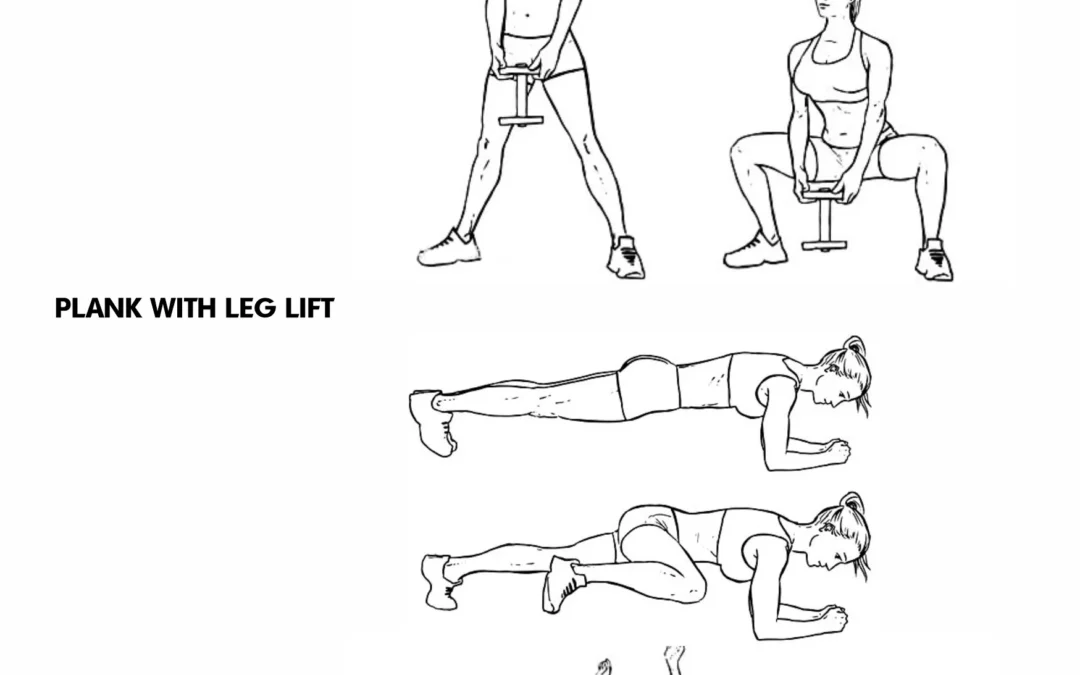
The squat-to-knee raise is a full-body exercise that combines the benefits of lower-body strength training with core engagement. Begin by performing a standard squat, and as you rise, lift one knee towards your chest. Alternate legs with each squat, focusing on engaging the lower abs as you lift your knee.
2. Plank with Leg Lift
The plank is a foundational core exercise, and adding a leg lift increases the challenge for the lower abs workout. Begin in a standard plank position. While maintaining a straight line from your head to your heels, lift one leg off the ground, hold for a few seconds, and switch legs. This exercise enhances core stability and lowers abs engagement.
3. Burpee to Tuck Jump
Burpees are complete body exercises that boost cardiovascular endurance while working multiple muscle groups. Adding a tuck jump at the end of the burpee increases the intensity and engages the lower abs. Perform a standard burpee, and as you jump, bring your knees towards your chest in a tuck jump before landing.
Creating a Balanced Workout Routine
Creating a balanced workout routine is essential for achieving optimal fitness. By incorporating a mix of strength training and exercises, you ensure that all major muscle groups are engaged. A well-rounded routine promotes long-term health, reduces the risk of injury, and helps maintain motivation by keeping your workouts varied and engaging.
1. Warm-Up
Before diving into your lower abs and full-body exercises, start with a dynamic warm-up. Include jumping jacks, high knees, and arm circles to get your blood flowing and prepare your muscles for the workout.
2. Workout Structure
For a balanced workout, combine two to three lower ab exercises with three to four full-body exercises. You can perform these exercises in a circuit, moving from one to the next with minimal rest. This structure elevates your heart rate, maximizing calorie burn and muscle engagement.
3. Cool Down and Stretching After completing your workout, cool down with light cardio, such as walking or cycling. Follow this with static stretching, focusing on the lower abs, hips, and legs to improve flexibility and prevent injury.
Conclusion: The Power of Combination
Combining lower abs workouts with full-body exercises is a powerful approach to achieving a strong, well-defined core and an overall fit physique. By integrating these exercises into your routine, you target the lower abs and enhance your core stability, boost calorie burn, and develop functional strength. Whether you’re a seasoned athlete or just starting your fitness journey, this combination can help you reach your goals more efficiently and effectively.
Ready to take your workouts to the next level? Join us at MultiFit and experience the benefits of a balanced, full-body workout routine. Our expert trainers will guide you through tailored workouts. Sign up today!
by indigiseo | Mar 1, 2026 | Exercises
8 Real Benefits of Superman Exercise You Need to Know
Never finished a long day with your shoulders hunched, back sore and breathing stilted?
I was one of those people until I discovered the benefits of superman exercise.
This easy action that never fails to draw ridicule on the internet, used to be my best friend in alleviating low-back pain, straightening posture and enhancing everyday strength, using none other than my body -and only the floor.
In a few days, I felt less insecure as I could stand in a taller and more fluid manner.
So, let us get into the explanation of why the superman exercise can be a revelation to you and how the efficient use of the superman pose can be retrofitted to any routine.
What Is the Superman Pose?
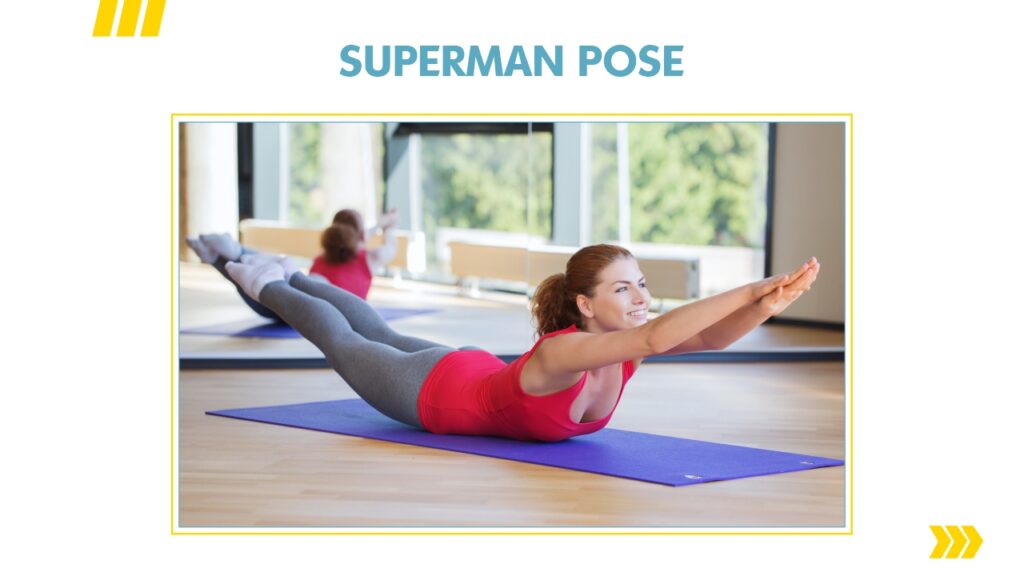
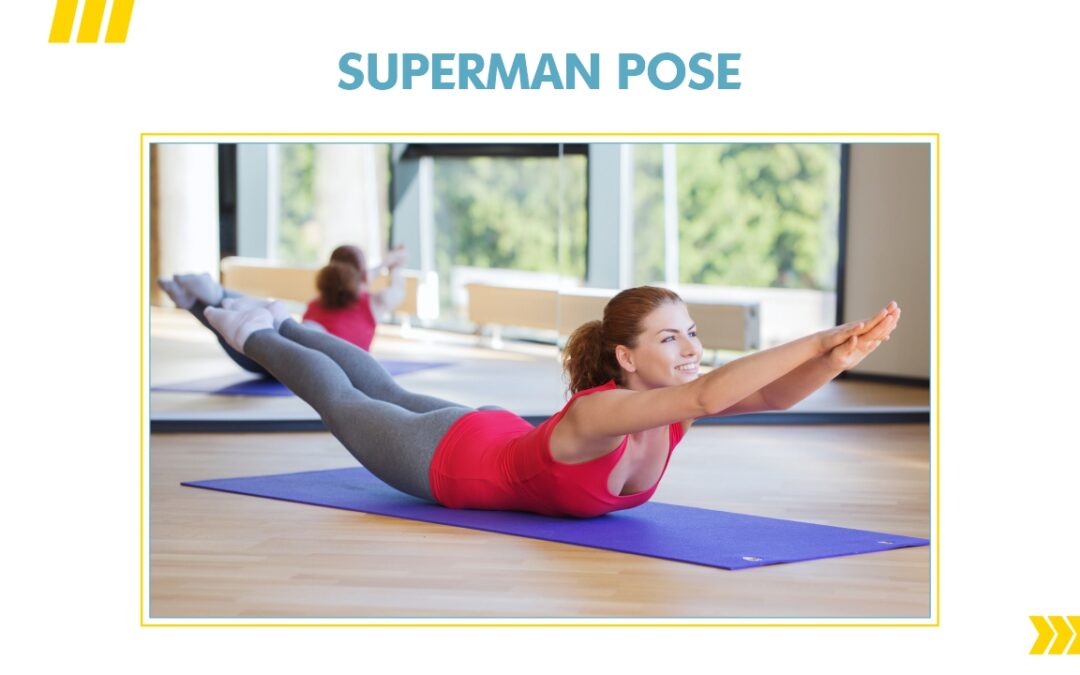
Superman pose exercise, also known as the superman pose yoga/body weight back extension involves the practice of lying face-down, with the arms extended in front of the body, in a manner that suggests that you are going to fly, which is followed by the movement of the arms and legs together.
It appears to be easy but involves multiple muscle groups at the same time.
Top Superman Exercise Benefits
Here are the most powerful superman exercise benefits I learned:
Strength in Back Muscles
The erector spinae- a chain that supports the spine is activated by the lifts. This increases the support in the spine and weakens chances of injury.
Improved Posture
Sleeping hours humped? This exercise powers up the muscles that help you to stand. It is described as a game changer.
Remedy of Lower Back Pain
The superman lifts are helpful daily to stabilize the lumbar sphere and minimize the pressure.
The Engagement of Full Posterior Chain
It wakes up the back deltoids and hard to reach areas, such as hamstrings, glutes and more. It’s the backbone of a posterior-chain.
Better Core Stability
You do not lift the back but work the abs, multifidus and obliques. Studies indicate that the stronger the core, the easier it moves and less injuries it entails.
Increase in Mobility/ Flexibility
Weak extension of the spine makes the back flexible without straining it especially when you sit a lot and it leaves the hips stiff.
No-Equipment, Easy Version
No mat, no tools–and you and the floor. It is affordable and pocket-friendly
Enhanced Mind – Body Connection
Keeping the focus on lift of arm and leg attracts consideration on breathing and motion.
How to Do the Superman Pose Exercise Safely
Follow these steps for proper form:
- Be lying on the mat, face downward, legs stretched, and arms raised up.
- Activate abdominals and buttock muscles.
- Breathe out, raise arms, chest and legs up in the air-think of flying.
- A 2-3 seconds hold: maintain the neck aligned with the spine.
- Slowly decrease gradually.
- Repeat 8 to 12 times or hold statically for 10 to 15s and isometric hold
Superman Exercise Variations
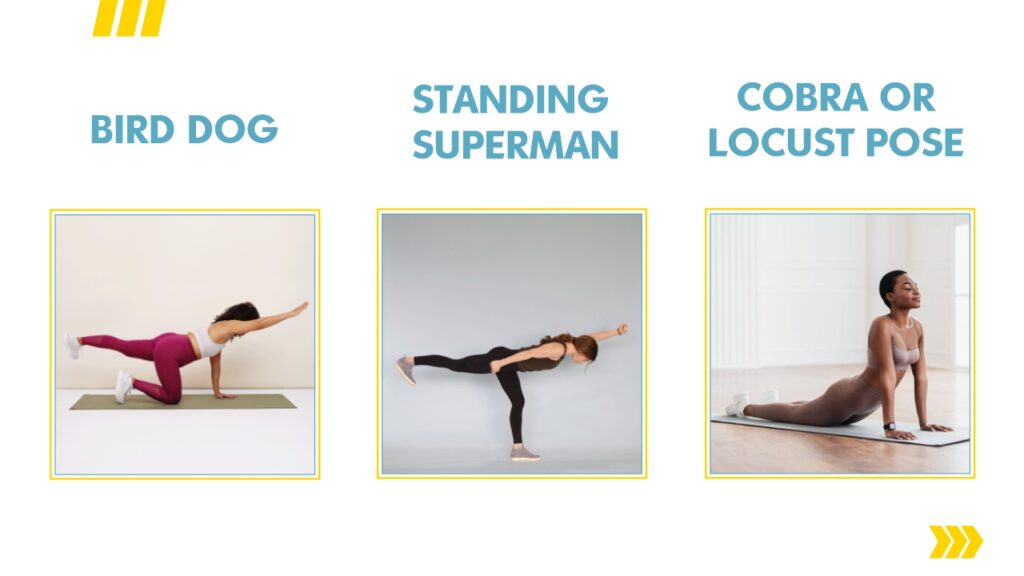
Bird Dog: While on hands and knees, reach opposite arms and legs out. Good for balance and oblique stability.
Standing Superman: While standing, hinge back at your hips and extend one arm and opposite leg. Good for balance.
Cobra or Locust Pose: A yoga back-bend variation that includes lifting the chest and upper-back instead of the legs.
Hints in Preparation
Keep it loose – don’t violently extend;
If your neck and/or lower back are sore, reduce range-of-motion, or make breaks between repetitions.
If you’re pregnant, just had abdominal surgery, or have some of the above rapid injurious events, modify or skip.
Finally, first begin with a simple hip-hinge, or a series of cat-cow to warm-up your lower-back and hamstrings.
Conclusion
In conclusion, the benefits of the Superman Exercise are more than looks.
It strengthens your back, helps develop better posture, feasts on unwanted pain, and keeps you consistent with everyday activity and ease.
It is a low- impact but high-value exercise that you can do anywhere!
If you sit a lot or often feel stiff, this exercise could have a meaningful change with little work. For the next week add a few repetitions each day, and see how your body feels.
FAQ’s
How often should I do Superman Exercise?
You may do it everyday, as long as it doesn’t irritate you. For added strength you would do it 2-3 times per week. Use either 8-12 repetitions or statically hold 10-15 seconds.
Will the Superman Exercise give me a big butt?
Yes, it is activating your glutes but it isn’t a butt workout. Consider it the bonus for spinal support.
Can Superman Exercise help my hunched shoulders?
Yes it helps with shoulder retraction because it activates the posterior chain to help improve your upper-body posture.
Is it safe for beginners?
Yes, just go slow. Reddit users mentioned that it helped their posture.
Should I static hold at the top or do repetitions?
Both are good for you! You may do one set of dynamic repetitions and static holds every time after that for some extra tension.
by indigiseo | Feb 28, 2026 | Aasan, Blog, Exercises, Health, Pranayama
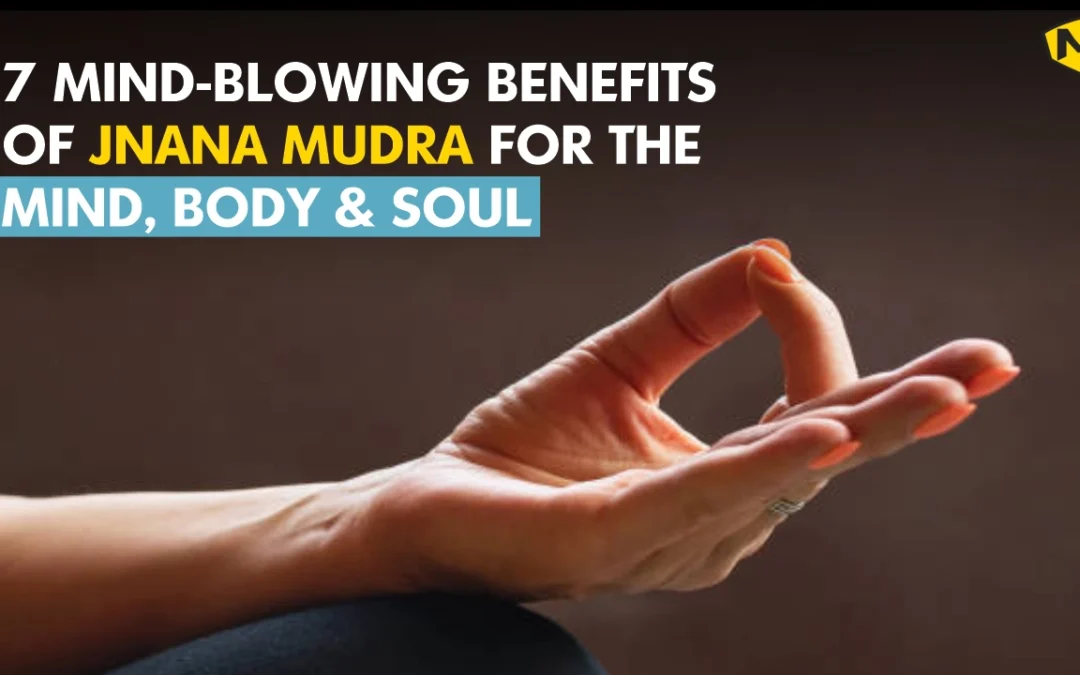
7 Mind-Blowing Benefits of Jnana Mudra for the Mind, Body & Soul
Have you ever felt overwhelmed with stress or found it hard to focus when life picks up speed?
I sure have. A simple hand position, jnana mudra benefits can help you regain clarity, calm, and well-being.
Less than two minutes with this hand position, will help you feel grounded and ready to engage in life in a more positive, fruitful way.
So, let’s dive in deep on what Jnana Mudra is all about.
What is Jnana Mudra and How to Do It?
The term jnana mudra means by having wisdom, that is, ‘jnana’ refers to ‘wisdom’ and ‘mudra’ refers to ‘gesture’.
It is also referred to as the gesture of knowledge.
How to Do it?
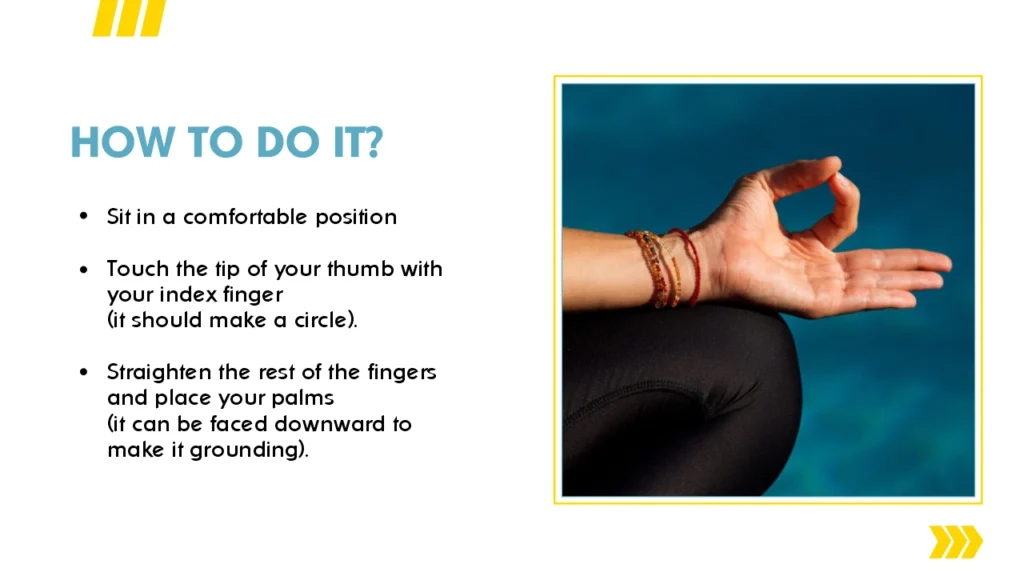
- Sit in a comfortable position
- Touch the tip of your thumb with your index finger (it should make a circle).
- Straighten the rest of the fingers and place your palms (it can be faced downward to make it grounding).
The thumb represents universal consciousness and the index finger is your self-bringing them together represents unity of the inner and outer worlds
Deep Dive into jnana mudra benefits
Increased Focus & Concentration
It establishes a “pranic circuit”, a circulation of life‑force energy within. That assists your brain in remaining more aware and relaxed.
Taming the Mind
Experience more consistent thinking and stop overthinking. After only a few minutes, practitioners report a silent mind space.
Improved Memory
Doing it 15 minutes a day can help the memory more than caffeine (with no crash!).
Anxiety and Stress Relief
This action relieves stress on the mind. It is subtle, but the change is real with time.
Better Sleep
A lot of users claim that they experience reduced night time tossing and turning when they use it prior to sleep.
Spiritual Connection
The gesture reminds of our inner side and universal run. It is based on the jnanayoga meaning, the yoga of knowledge and wisdom
Improved Communication & Peace
According to one of the studies, when hands take this position, peaceful energy just radiates, and interactions become easier
How to Practice for Maximum jnana mudra benefits
When To Do It
Perfect when meditating, studying, in a stressed situation or even before bedtime- 3 times a day shows results
How Long
Novices begin with 5 minutes. Increase slowly to 15-30 minutes to derive maximum benefit.
Optimal Sitting Position
Sukhasana (easy seat), padmasana (lotus), or even a chair, just sit up but relaxed
Breathing Tips
Breathe in and out through your nose slowly. There is no effort to be made, simply observe the breath.
Linking to jnana yoga meaning and what is jnana yoga in hinduism
Jnanayoga is the way of knowledge by employing study, contemplation and intuition in realizing our real nature. In Hinduism, it is one of the four primary yogas. It makes us doubt appearance and withdraw into ourselves to seek reunion with the divine. We manifest that awareness in everyday life through such tools as jnana mudra benefits.
Troubleshooting & Tips
Tired or stiff hands?
Warm up your fingers by bending and straightening them. Then be smooth into the gesture.
Which way do the palms face?
With palms down it is grounding (jnana mudra). Palms up move to receptivity (chin mudra)
Fingers not staying touching?
Instead, beginners can touch the thumb to the center of the index finger, it seems more secure.
Conclusion
There are no specific instruments or long practices required: the jnana mudra advantages are in its simplicity. Even a few minutes a day will give you an opportunity to open a door to clearer thinking, inner peace and greater presence. It connects wonderfully with yoga definition and advantages, and brings you to harmony in mind, body and spirit. And, it connects with the core of jnana yoga meaning. Will you do it now, just as I have suggested, finger tips together, breathe in consciousness, breathe out strain, and discover how this little action can transform your world.
Frequently Asked Questions
Can children practice it?
Yes, it is mild and harmless. It is simple, just touch your finger and thumb, and hold it a few minutes to make you feel calm.
Are there any side effects?
None known. Only avoid it when you have injuries on the wrist or finger.
How is it different from Chin Mudra?
Chin mudra is nearly the same shape, but with palms up – resulting in a greater receptivity. jnana mudra is enhanced by palms down -more grounded and introverted.