by indigiseo | Mar 4, 2026 | Exercises
Crunch Exercise: Strengthen Your Core with Precision
Does it happen to you that after spending a long time at work, there’s a twinge in your lower back?
Did you notice your posture start to slump as you walked in the evening?
Usually, these small-scale aches show a weak core.
This simple crunch exercise allows you to focus on your core which helps deal with some back pain problems. We’ll discuss what this exercise involves, the correct way to perform it and how it can help you every day.
What Is a Crunch Exercise?
A crunch exercise focuses on strengthening your core by hitting the rectus abdominis which many people want for a six-pack appearance.
Crunches differ from sit-ups because you lift only your upper shoulders and back, keeping the rest of your back pressed firmly.
By isolating your torso, crunches are good for your abs and easy on your lower back.
Benefits of Crunches
Core Strength: Regular exercise crunches work out your core muscles and can give you better posture and pain-free back.
Improved Stability: A strong core improves your ability to balance and coordinate your movements in everyday life.
Accessibility: Anyone can do crunches with little or no equipment and they can fit into your workout anytime, anywhere.
Versatility: Crunches can be easily changed to meet the needs of people who are just starting out as well as those who are experienced.
How to Do a Proper Crunch Exercise
Learning how to do a proper crunch exercise helps you gain many benefits and avoid injuries.
Starting Position:
Place your back on the floor, bend your knees and rest your flat feet at hip-width distance.
Put your arms across your chest or lightly put your fingertips behind your ears.
Engage your core by pulling your belly button toward your spine.
Execution:
As your head, neck and shoulders lift up off the floor, also lift your abdomen without letting your lower back rise.
Keep your lower back pressed into the floor throughout the movement.
Pause briefly at the top of the movement.
Return:
Breathe in and use control to return your upper body back down to the beginning position.
Tips:
Avoid pulling on your neck with your hands.
Focus on using your abdominal muscles to lift your upper body.
Try to move with careful control so the muscles feel the exercise.
Common Mistakes to Avoid
Neck Strain: Fiddling with your neck could bring you pain or harm your neck. Lightly place your hands on your ears and focus on using your core.
Don’t use Momentum: Rough movements can make you less efficient and raise your risk of injury. Take your time and do crunches one at a time.
Lifting Lower Back: When lifting your lower back, be sure it is against the floor for the best workout.
Holding Breath: Remember, when you’re holding breath, exhale when you come up and breathe in when you head under again.
Variations to Enhance Your Routine
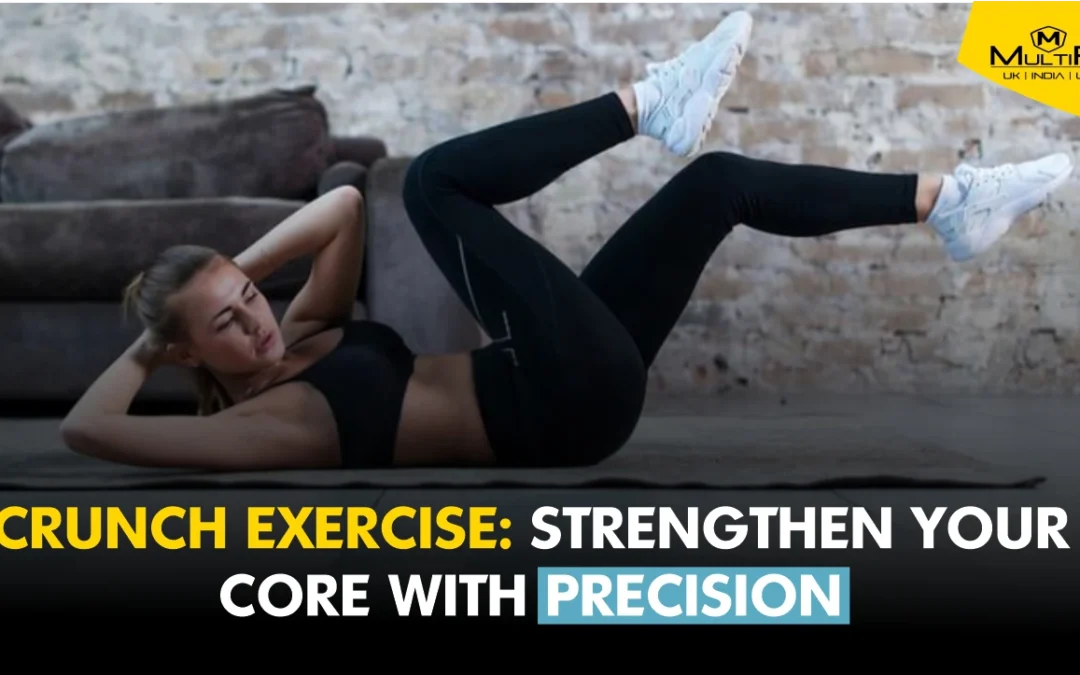
Bicycle Crunches: With Bicycle Crunches, twist your body to the left as you raise your right leg and back to the right as you bend your left leg.
Reverse Crunches: Pay attention to working your lower abdominal muscles by pulling your hips up off the floor.
Stability Ball Crunches: A stability ball is a good way to do crunches, adding flexibility and activating muscles that help keep your body stabilized.
Standing Oblique Crunches: Performing oblique crunches while upright helps tone the waist and makes you feel more balanced.
Crunches into Your Fitness Routine
Frequency: It is good to exercise 2–3 times a week, making sure you have breaks between exercises.
Repetitions: At first, do 2–3 sets of at least 10 repetitions, paying close attention to how you lift weights.
Progression: Move forward by repeating exercises more often or by trying variant options once you become stronger.
Complementary Exercises: For a better workout, try crunches along with planks and leg raises.
Conclusion
Including crunch exercise will strengthen your main muscles and can help your posture and ease your everyday pain.
The health benefits of this exercise are numerous.
Knowing how to do crunches correctly and without errors and sort of managing the way you progress in difficulty is also advantageous to realize through the use of crunches.
Moving and maintaining the same patterns and posture is important to achieving your health and fitness goals.
FAQ’s
How do crunches differ from sit-ups?
Crunches focus on lifting the upper back and shoulders while you strengthen your abdominal muscles. You use your hip flexors in addition to your core muscles when you do a sit-up.
Can crunches help me lose belly fat?
Crunches work the abs but don’t necessarily melt the fat in your belly. You achieve better results for fat loss by combining crunches, cardio and eating healthily.
Are crunches safe for people with back issues?
When done as instructed, crunches are safe to do. Still, those with back problems should get medical advice before beginning any new exercise program.
How often should I do crunches?
Fit in crunches in your workout plan 2–3 times a week, so you don’t overstress your muscles.
What’s the best way to progress with crunches?
While becoming stronger, perform each move several times and think about changing things up for your workouts.
by indigiseo | Mar 4, 2026 | Health
One of the upper body exercises focused chiefly on the chest, shoulders, and triceps is the bench press. The three major variations of the bench press are the flat, incline, and decline bench presses. All of these forms have different advantages and train different parts of the chest muscles. Now, this blog will explain these variations in simple terms so that you know which one to use for your desired physique.
What is a Bench Press?
The bench press is exercised by lying on your back on a bench; you press a weight upwards. It can be done with a barbell, dumbbell, or a machine. The aim is to lower the weight down to your chest and then push it back up. That makes it one of the staple exercises for anyone looking to gain muscle mass and strength in the upper body.
Flat Bench Press
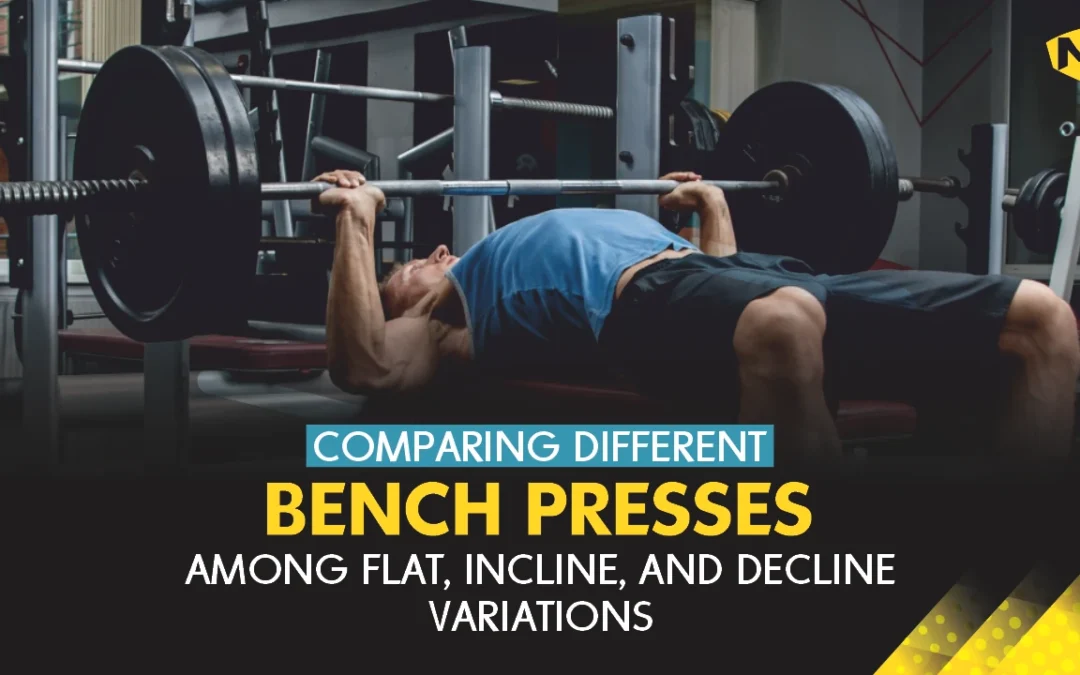
The flat bench press is the most practiced. You lie flat on the bench, pressing the weight upwards, developing your chest overall.
Muscles Worked
The Flat Bench Press targets mainly the middle part of your chest, the front of your shoulders, and your triceps.
How to Do This Exercise?
- Lie flat on a bench with your feet planted on the ground.
- Grip a barbell with hands slightly wider than shoulder-width.
- Lower the weight to your chest, just above the nipple line.
- Press the barbell back up until your arms are fully extended.
- Repeat for the desired number of repetitions.
Benefits of Flat Bench Press
- Development of chest muscles: A Flat Bench Press will provide the overall development of your chest muscles.
- Core Stability: This exercise does a great deal of work in building core strength by stabilizing the weight.
- Simplicity: It is very simple and easy, making it a good starting point for beginners.
Incline Bench Press
The Incline bench press occurs on a bench that is set to an angle. Normally, this angle is anywhere between 30 and 45 degrees. This variation shifts focus to the upper chest and the shoulders.
Muscles Worked
The incline bench press on chest targets the upper chest and places a greater emphasis on the anterior deltoids than the flat bench press does.
How to Do This Exercise?
- Adjust the bench at an angle so that it’s on an incline.
- Lie back on your bench with your feet flat on the floor.
- Grip a barbell with your hands slightly wider than shoulder-width apart.
- Lower the barbell down to your chest, toward the collarbone.
- Press the barbell up to full extension.
- Repeat as necessary for the number of repetitions.
Benefits of Incline Bench Press
- Upper Chest Focus: This variation focuses on the upper chest, which significantly enhances the overall appearance of your chest.
- Improved Shoulder Strength: The incline angle hits the shoulders harder.
- Variety In Exercises: It adds variety to your workout routine, hence reducing muscle imbalances.
Decline Bench Press
Decline bench press is on a bench set on an angle downward. This variation thus activates the lower part of the chest more and involves the triceps to a greater degree.
Muscles Worked
This variation still works more on the lower part of the chest but involves the triceps a bit more than the above variations.
How to Do This Exercise?
- Move the bench to a downward angle.
- Lie back and put your feet under the foot pads.
- Grip the barbell with your hands slightly wider than shoulder-width apart Lower the barbell towards your lower chest.
- Press the barbell back up until your arms are extended
- Repeat for desired repetitions.
Benefits of Decline Bench Press
- Lower chest focus: This variation is excellent for targeting the lower chest, which can improve the overall definition of your chest.
- Reduced shoulder strain: The decline angle can be easier on the shoulders.
- Increase triceps engagement: This exercise engages the triceps more and helps to develop arm strength.
Bench Press on Machine
You can perform the bench press on a machine, such as a smith or a chest press machine. Machines guide the movement, making the exercise more controlled and safe, especially for beginners.
Muscles Worked
Machine bench presses do much the same thing as the free weight options— chest, shoulders, and triceps, but the range of motion tends to be shorter.
How to Do This Exercise?
- Adjust the height of the machine so that it is comfortable.
- You can either sit or lie down on the machine, depending on how its design suits you.
- Grasp handles or bars with a wider-than-shoulder-width grip.
- Press the weight up by fully extending your arms.
- Lower weight slowly down again.
- Do for reps.
Benefits of Bench Press on Machine
- Controlled motion: The machines limit your movement, which teaches you proper form if you’re new to weight-lifting.
- Safety: They minimize the risk of injury, especially when you’re working with heavier weights and alone in the gym.
- Muscle focus: This also puts your mind into the muscles you are working on as you don’t need to maintain your balance.
What Kind of Bench Press is for You?
The flat bench press works well for the overall development of the chest and the first way of doing it depends on the fitness goal you have in mind. If you want to build your upper chest, we suggest you do the incline bench press. But if you want to focus on the lower chest, it’s best to stick with the decline bench press.
If you’re a beginner, though, or have safety concerns, a machine bench press provides a controlled environment where you can learn proper form.
Conclusion
The bench press is a very broad-ranging exercise, with variations utilized to hit the chest and upper body differently. Integrate bench presses-flat, incline, and decline-along with machine presses into your workouts for a great overall chest and upper body. Just make sure to perform the movement correctly, begin with a suitable weight, and adjust as necessary to achieve your goals.
Want to master the perfect bench press? Join MultiFit Gym and let our trainers help you with flat, incline, and decline variations to reach your fitness goals.
by indigiseo | Mar 4, 2026 | Exercises
Achieving a well-defined core is a common fitness goal, but many need to pay more attention to the importance of a balanced workout routine. While targeting the lower abs is crucial for building a solid core, combining these exercises with full-body workouts can take your fitness to the next level. In this blog, we’ll explore the benefits of integrating lower abs workout with full body exercises, the best exercises to incorporate, and how this combination can help you achieve a well-rounded and powerful physique.
The Importance of Lower Abs Workouts
The lower abs workout plays a crucial role in building a strong and stable core, serving as the foundation for improved posture, balance, and overall body strength. Incorporating these into your routine is essential for achieving a well-rounded, functional fitness level and contributes to a more defined, toned midsection.
Understanding the Lower Abs
The lower abs are part of the rectus abdominis, the muscle that runs vertically along the front of your abdomen. This muscle is responsible for flexing the spine and stabilizing the pelvis. The lower abs, in particular, are often the most challenging to target, but they are essential for maintaining a strong and stable core. Focusing on lower abs workouts can help you build the foundation for core strength.
Benefits of Lower Ab Exercises
Lower ab exercises offer numerous benefits:
- Strengthens Core Stability: Enhances overall core strength, improving balance and posture.
- Improves Athletic Performance: Boosts power and efficiency in activities like running and lifting.
- Supports Lower Back Health: Reduces the risk of lower back pain by stabilizing the spine.
- Enhances Flexibility: Increases mobility in the hips and pelvis, leading to better movement.
- Aids in Functional Movements: A strong lower core facilitates daily tasks like bending and lifting. It also supports the spine and pelvis, which is crucial for maintaining proper alignment during various activities.
- Contributes to Aesthetic Goals: Helps define and tone the lower abdominal area, contributing to a leaner appearance.
- Boosts Metabolism: Engages multiple muscle groups, which can lead to increased calorie burn.
Why Combine Lower Abs Workouts with Full-Body Exercises?
Combining lower abs workout with full-body exercises maximizes the efficiency of your fitness routine. This approach not only strengthens and tones your core but also enhances overall body coordination, and stability. By pairing lower abs exercises with full-body routines, you achieve a more balanced and effective workout, leading to better results in less time.
1. Maximizing Efficiency
Combining lower abs workouts with full body exercises maximizes your workout efficiency. Instead of dedicating separate sessions to lower abs and full-body training, you can integrate both into a single routine. This approach not only saves time but also ensures that your workouts are balanced, addressing multiple muscle groups simultaneously.
2. Enhancing Core Stability
Full-body exercises often engage the core, including the lower abs, as stabilizers. By combining lower abs exercises with full-body movements, you enhance core stability and improve overall body coordination. This integration helps you develop functional strength, leading to better performance in sports and daily activities.
3. Boosting Calorie Burn
When you incorporate full-body movements into your lower abs workout, you increase your session’s intensity and calorie burn. Full body exercises such as squats, deadlifts, and burpees engage large muscle groups, elevating your heart rate and boosting your metabolism. This combination can help you burn more calories and fat, making achieving a lean, toned physique easier.
Effective Lower Abs Exercises
Effective lower abs exercises target the deep core muscles, helping to build strength and definition in the lower abdomen. Incorporating these exercises into your routine can significantly enhance core stability, support lower back health, and contribute to a more toned, sculpted midsection.
1. Leg Raises
Leg raises are a classic lower abs workout that effectively targets the lower portion of the rectus abdominis. Lie flat on your back with your legs extended to perform leg raises. Slowly lift your legs towards the ceiling while keeping them straight. Lower your legs back down without letting them touch the ground, and repeat.
2. Reverse Crunches
Reverse crunches are another excellent exercise for the lower abs. Begin by lying on your back with your knees bent and feet flat on the floor. Lift your hips off the ground while bringing your knees towards your chest. Lower your hips back down slowly and repeat the movement.
3. Mountain Climbers
Mountain climbers are dynamic exercises that engage the lower abs while also providing a cardio boost. Start in a plank position with your hands directly under your shoulders. Drive one knee towards your chest and then quickly switch legs, mimicking a running motion while keeping your core engaged.
Integrating Full-Body Exercises with Lower Abs Workouts
Effective lower abs exercises target the deep core muscles, helping to build strength and definition in the lower abdomen. Incorporating these exercises into your routine can significantly enhance core stability, support lower back health, and contribute to a more toned, sculpted midsection.
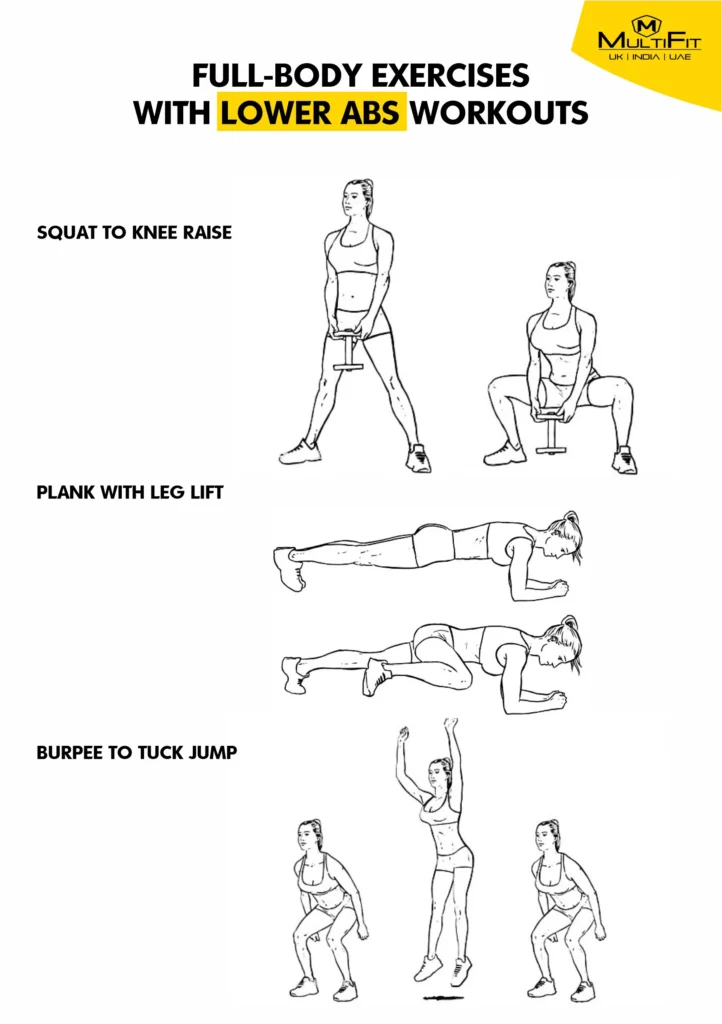
1. Squat to Knee Raise
The squat-to-knee raise is a full-body exercise that combines the benefits of lower-body strength training with core engagement. Begin by performing a standard squat, and as you rise, lift one knee towards your chest. Alternate legs with each squat, focusing on engaging the lower abs as you lift your knee.
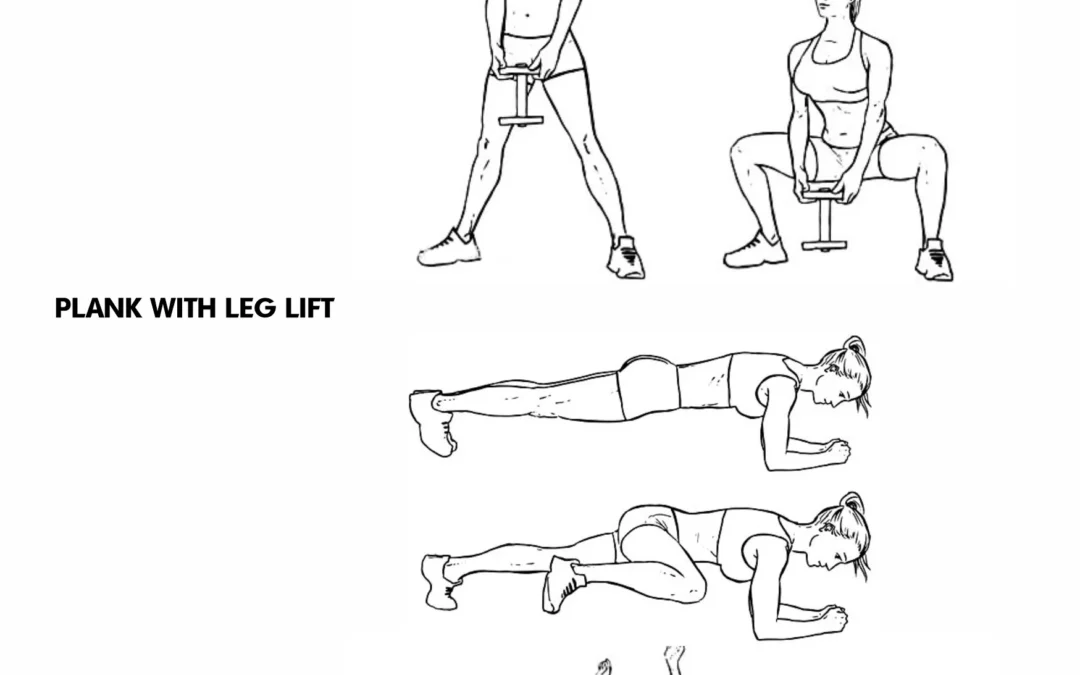
2. Plank with Leg Lift
The plank is a foundational core exercise, and adding a leg lift increases the challenge for the lower abs workout. Begin in a standard plank position. While maintaining a straight line from your head to your heels, lift one leg off the ground, hold for a few seconds, and switch legs. This exercise enhances core stability and lowers abs engagement.
3. Burpee to Tuck Jump
Burpees are complete body exercises that boost cardiovascular endurance while working multiple muscle groups. Adding a tuck jump at the end of the burpee increases the intensity and engages the lower abs. Perform a standard burpee, and as you jump, bring your knees towards your chest in a tuck jump before landing.
Creating a Balanced Workout Routine
Creating a balanced workout routine is essential for achieving optimal fitness. By incorporating a mix of strength training and exercises, you ensure that all major muscle groups are engaged. A well-rounded routine promotes long-term health, reduces the risk of injury, and helps maintain motivation by keeping your workouts varied and engaging.
1. Warm-Up
Before diving into your lower abs and full-body exercises, start with a dynamic warm-up. Include jumping jacks, high knees, and arm circles to get your blood flowing and prepare your muscles for the workout.
2. Workout Structure
For a balanced workout, combine two to three lower ab exercises with three to four full-body exercises. You can perform these exercises in a circuit, moving from one to the next with minimal rest. This structure elevates your heart rate, maximizing calorie burn and muscle engagement.
3. Cool Down and Stretching After completing your workout, cool down with light cardio, such as walking or cycling. Follow this with static stretching, focusing on the lower abs, hips, and legs to improve flexibility and prevent injury.
Conclusion: The Power of Combination
Combining lower abs workouts with full-body exercises is a powerful approach to achieving a strong, well-defined core and an overall fit physique. By integrating these exercises into your routine, you target the lower abs and enhance your core stability, boost calorie burn, and develop functional strength. Whether you’re a seasoned athlete or just starting your fitness journey, this combination can help you reach your goals more efficiently and effectively.
Ready to take your workouts to the next level? Join us at MultiFit and experience the benefits of a balanced, full-body workout routine. Our expert trainers will guide you through tailored workouts. Sign up today!
by indigiseo | Mar 4, 2026 | Yoga
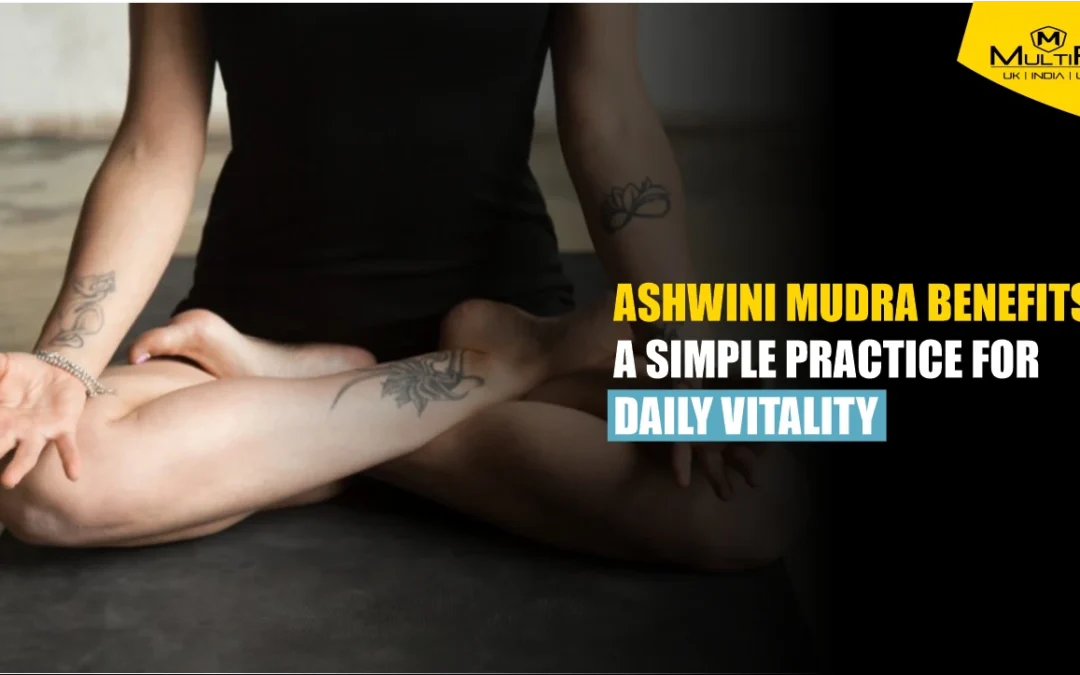
Ashwini Mudra Benefits: A Simple Practice for Daily Vitality
Does inactivity or rapid movement ever cause you to feel sluggish, tense, or drained – especially at the end of a day?
We all have.
That’s why Ashwini Mudra benefits us in many ways. It is easy to integrate this quick yoga move for anyone who sits on a desk or is just lounging before bed. With only a few minutes of easy non-noisy movements, you can promote digestion, silence thoughts, and increase attention. And the best part? Before long you will feel a difference.
What Is Ashwini Mudra?
The Sanskrit word of “Ashwini” is equivalent to the notion of “horse”, and “Mudra” refers to a physical or mental gesture.
The technique involves deliberate tensing of releasing the anal sphincters muscles in a horse-like pattern.
This method is greatly subtle and effective in controlling the body energy and developing strength in the pelvic region.
How to Do Ashwini Mudra
Ashwini Mudra is easy to perform and no special arrangement is required:
- Find a Comfortable Position: While you sit in a lotus, thunderbolt or lying position, you can practice Ashwini Mudra.
- Relax Your Body: Give yourself a couple of soothing breaths to relax your mind and body.
- Contract the Anal Muscles: Gently press in and lift the muscles around your anus as if you were trying to prevent a bowel movement.
- Hold and Release: Hold your squeeze for a few seconds and then let your anal muscles slowly loosen.
- Repeat: Do the exercise for 10 to 15 repetitions per session.
- Consistency: Establish a routine, incrementing the duration of a session and the number of repetitions you make with increasing skill.
Morning is when this practice is most capable or the best setting for meditation can be established.
After indulging yourself into your meals, take some time and work on this practice.
Ashwini Mudra Benefits
1. Enhances Digestive Health
Regular practice also revives the digestive system and can ease out symptoms like experiencing constipation, feeling bloated, and indigestion. In the strengthening of rectal muscles, Ashwini Mudra helps both comfortable and normal bowel movement.
2. Strengthens Pelvic Muscles
By focusing on the muscles of the pelvic floor, this pose assists the muscles that reinforce the bladder, uterus and rectum. Stimulation of these muscles reduces the risk of urinary incontinence and increases the pelvic well-being.
3. Boosts Sexual Health
The offer of Ashwini Mudra benefits for male is actually quite good because it includes controlled ejaculation and increased sexual stamina. Also, it bulks blood flow to the pelvic region implying support of prostate health.
4. Activates Energy Centers
This mudra provides an upward freedom to the energy in the body that activates the Muladhara chakra. In turn you might feel an energy surge and become more grounded.
5. Aids in Spiritual Growth
Its competency towards directing energy upwards helps to unblock and energise dormant centers, thereby propelling spiritual practices and increasing awareness.
6. Improves Focus and Mental Clarity
The act of focusing on the practice makes one’s mind clear, reduces stress and prepares one for inner peace.
Ashwini Mudra Side Effects
While Ashwini Mudra is generally safe, it’s essential to be aware of potential side effects:
- Muscle Strain: Overexertion can lead to discomfort in the pelvic region.
- Hemorrhoids: Excessive pressure may aggravate existing hemorrhoids.
- Rectal Prolapse: Rare but possible with improper practice.
- Disrupted Bowel Movements: Some may experience temporary changes in bowel habits.
- Increased Sexual Arousal: Heightened energy in the pelvic region may lead to increased arousal, which could be distracting for some.
Precautions
Medical Conditions: Avoid if you have high blood pressure, heart disease, or have undergone recent abdominal surgery.
- Pregnancy: Not recommended during pregnancy, especially after the first trimester.
- Menstruation: Women should avoid practicing during their menstrual cycle.
- Proper Technique: Ensure you’re not straining; the practice should be gentle and controlled.
Ashwini Mudra Position
Sit in a relaxed, erect position while keeping your spine straight in order to relax the body during this posture.
The main thing is to work with the anal sphincter muscles, working on alternate contractions and reliefs.
It is possible to practice in this way while meditating or incorporate into a wider array of seated yoga practice.
Ashwini Mudra Yogasan
Combined with specific yoga postures it might be possible to reshape the Ashwini Mudra and its capacity for deeper practice:
Padmasana (Lotus Pose): Promotes stability and concentration.
Vajrasana (Thunderbolt Pose): Promotes proper digestion and enables sustained without strain performance.
Sukhasana (Easy Pose): Ideal for beginners, promoting relaxation.
When used along with Ashwini Mudra, these poses make your practice better and emphasize their benefits more.
Conclusion
Ashwini Mudra into your daily routine may really turn your well-being around.
This light but powerful exercise can improve your general health, purify your mind and spiritual bonds.
It doesn’t matter if your goal is better digestion, better pelvic health, or just some inner calming down, this practice is a simple and efficient option. Just add it in your daily routine for several minutes, and you will be feeling the positive shifts arise.
FAQ’s
Can beginners practice Ashwini Mudra?
It is simple to practice and all levels of ability are applicable.
How often should I practice Ashwini Mudra?
You are encouraged to begin with limited minutes throughout the day and increase gradually as your skills improve.
Is Ashwini Mudra beneficial for women?
Indeed, regular practice strengthens pelvic muscles, keeps reproductive wellness, and can also aid recovery after birth.
Can I practice Ashwini Mudra during menstruation?
Practice during the menstruation is not recommended, as any discomfort can ease up.
Does Ashwini Mudra help with stress?
Really, through working out muscles and consciously breathing you’ll relax more and reduce your stress levels.
by indigiseo | Mar 4, 2026 | Aasan
10 Reasons Why Janu Shirshasana Eases Tension and Boosts Flexibility
Your body demands relief when you finish a busy day working at a desk or commuting.
Seated stretch therapy creates a two-fold benefit because it alleviates back tension and promotes mental serenity.
The Head on Knee Pose known as Janu Shirshasana serves as a response to your present need. The gentle forward stretch provides both physical and mental relief which helps people rest from daily stress.
Understanding Janu Shirshasana (Head on Knee Pose)
One of classical Sanskrit origins the term Janu Shirshasana draws its names from ‘Janu’ for ‘knee’ while ‘Shirsha’ indicates ‘head’ and ‘Asana’ represents ‘pose’.
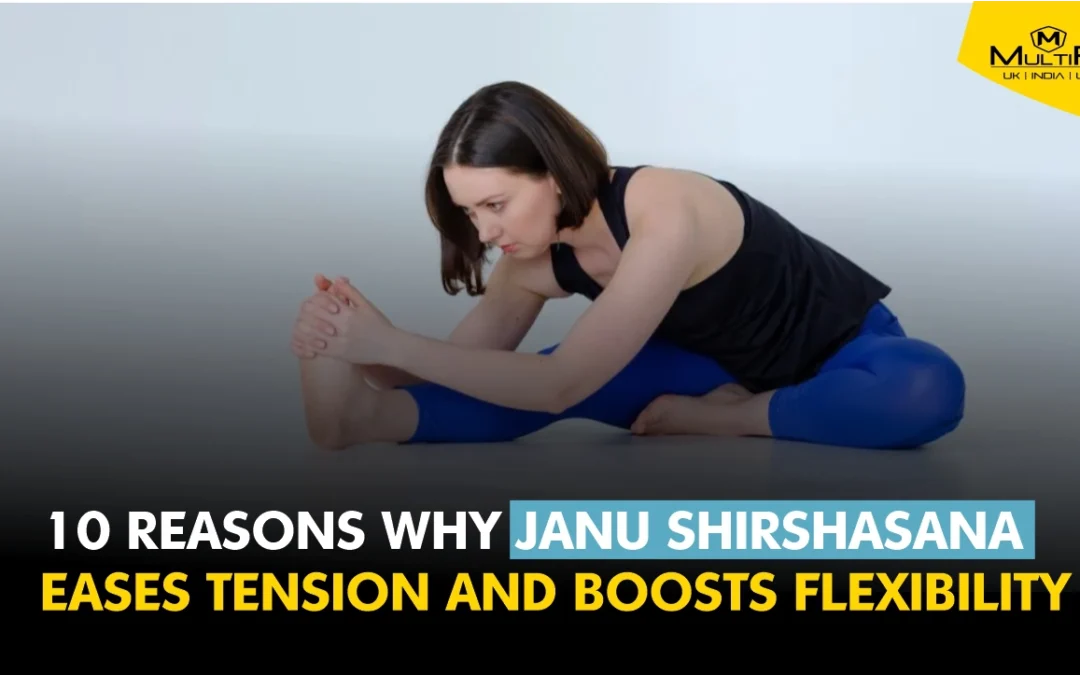
Thus Janu Shirshasana consists of a seated forward bend with extended leg along with bent knee bringing the head close to that knee.
New practitioners can approach this pose easily because it provides significant advantages through repeated practice.
Benefits of Janu Shirshasana
1. Enhances Flexibility
Through regular practice of Janu Shirshasana the hamstrings together with the calves and lower back muscles become stretched which leads to improved flexibility. The extended flexibility brought by this pose allows people to move more easily and limits their chances of experiencing injuries.
2. Strengthens the Spine
The forward bending position in this posture extends and fortifies the spine structure which results in decreased back tension and enhanced body position.
3. Stimulates Digestive Organs
When performing Janu Shirshasana the body compression activates a digestive organ massage that supports their operation and leads to better digestion.
4. Calms the Mind
Deep breaths with steady inhalations become possible in this pose which helps people achieve meditative states while reducing their stress levels. Post-hectic days this position effectively helps people relax.
5. Relieves Menstrual Discomfort
Regular practice of Janu Shirshasana through female bodies can soften menstrual discomfort and pelvic tension while stretching those areas.
6. Improves Circulation
This pose performance brings improvement to pelvic region blood flow which results in better body circulation for increased vitality.
7. Boosts Mental Clarity
True concentration and mental clarity develop through breath awareness along with proper alignment practice during Janu Shirshasana because it creates a mindful state of mind.
Importance of Janu Shirshasana
The various benefits of Janu Shirshasana create its significance as a yoga pose. Through its stretching and muscle strengthening effects the pose gives physical benefits and establishes mental relaxation.
Practicing this pose brings multiple advantages that improve both posture and digestion along with mental calmness.
How to Perform Janu Shirshasana
Dandasana (Staff Pose) represents the starting position where you should sit with legs outstretched facing forward.
Gently pull the left foot to position it against your right thigh inner surface.
Lift your hands above your head as you lengthen your backbone during inhalation.
During exhalation slowly bend at your hips to lower yourself forward over the extended right leg while maintaining a straight spine position.
This pose needs to be sustained from 30 seconds to 1 minute while deeply breathing.
Complete the move again by starting over in the beginning position then move between legs.
Precautions and Modifications
Use Props: If you have tight hamstrings, sit on a folded blanket or use a strap around the foot of the extended leg to avoid strain.
Avoid If Injured: Individuals with knee, back, or spinal injuries should consult a healthcare professional before attempting this pose.
Listen to Your Body: Never force the stretch; go only as far as comfortable to prevent injury.
Conclusion
Practicing Janu Shirshasana daily brings both mental tranquility and various body advantages.
With its gentle yet potently beneficial nature this stance provides users a practice method to manage back tension and digestion and achieve mental clarity.
Accept the Head on Knee Pose to develop your physical and mental well-being and create a state of equilibrium and calmness in your life.
FAQ’s
Can beginners practice Janu Shirshasana?
Starting practitioners can perform this position. The practice can begin through uses of props which include blankets or straps to establish a safe entry point.
How long should I hold the pose?
Each side of the posture should be held between 30 seconds and 1 minute while focusing on deep breathing.
Is Janu Shirshasana beneficial during menstruation?
The practice of this pose enables reduction of menstrual symptoms through gentle stretching of the pelvic region.
What muscles does the pose target?
This pose extends both the hamstrings and calves as well as spine and shoulders and groins to improve flexibility and build strength.
Who should avoid this pose?
People with knee, spinal or back injuries need to stay away from this pose yet consulting medical experts offers an alternative for practice.